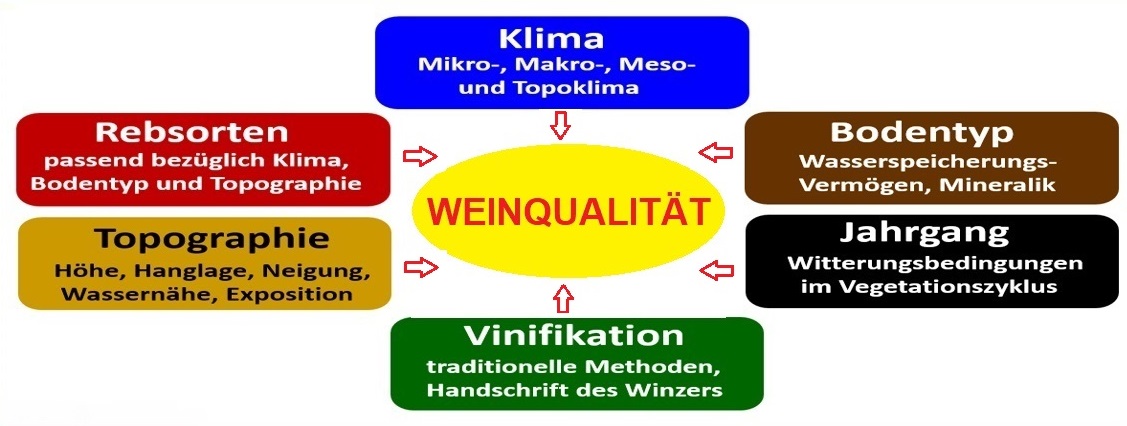
Alongside climate and grape variety, this is one of the most important factors influencing wine quality. The different types of soil have formed over millions of years through the physical and chemical weathering of rocks and the humification of organic matter. During physical weathering over extremely long periods of time, natural forces such as wind, water, heat, cold and frost initially cause the mechanical crushing of the rock formations into boulders and gravel. Strong temperature contrasts, frictional and shear forces as well as frost blasting by frozen water play a decisive role here.
Various chemical weathering processes such as oxidation, dissolution processes and acid attacks attack the mineral lattice structure of the rocks. Easily water-soluble minerals such as carbonates (inorganic salts and organic esters of carbonic acid) and sulphates (salts and esters of sulphuric acid) are dissolved first. This causes the rock to decompose very slowly into grit, sand, silt or clay. Every rock, even the hardest marble, granite or quartz, will eventually disintegrate into dust, even if this can take millions of years.
Organic substances from plant residues, animal residues from worms, insects and small animals of all kinds as well as dead microorganisms such as algae, bacteria and fungi are converted into humus. This releases the nitrogen compounds(nitrates, ammonium) essential for plant growth as well as other nutrients. Fungi and bacteria play the main role in the decomposition of organic residues such as wood, leaves, roots or animal carcasses. Soil mites are important because of their crushing feeding activities. Earthworms play a decisive role in soil loosening, mixing and the formation of stable clay-humus complexes, which are formed in the earthworm gut and excreted as faeces. These contribute to the structural stability of the soil and can bind easily water-soluble nutrients, making them available to plants for longer.
Soil horizons
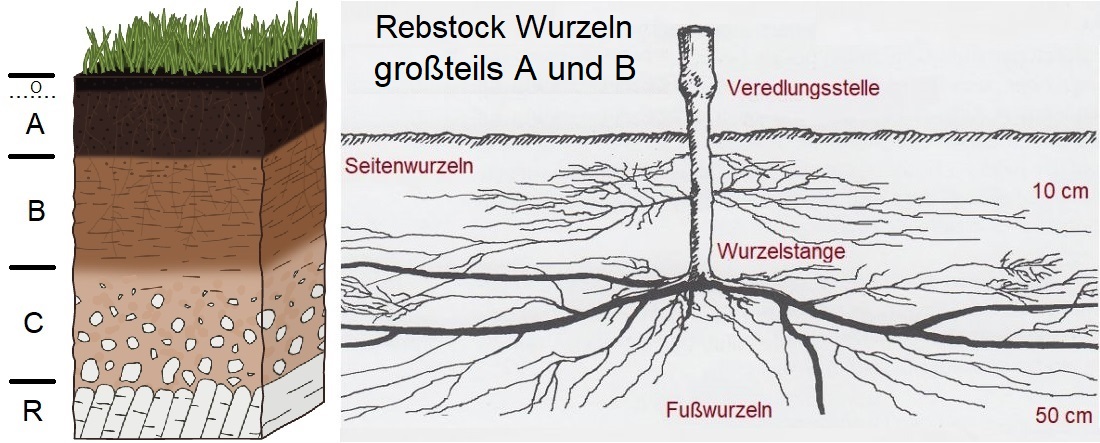
Every soil consists of soil horizons (soil layers) with special properties. They are almost always horizontal and can be recognised in the soil profile (vertical section of the soil in an excavation). The sequence is the essential criterion for determining the soil type. From top to bottom, a soil is divided into an O horizon (organic soil horizon) or also H-L-O horizon (peat from plant residues, litter) and a three-part mineral horizon with A horizon, B horizon and C horizon.
Symbols
Horizons are mixed by deep mechanical tillage. Depending on the climate and the effects of erosion, the A or B horizon may be absent or only marginally developed. The individual horizons are labelled with symbols. The main symbols are labelled with capital letters, the additional symbols (features due to soil formation or pedogenic features) are labelled with lower case letters after the main symbol:
Main symbols
- O = organic topsoil (except peat), O from organic
- A = mineral topsoil with revitalised, humus-rich layer
- B = mineral subsoil with humus-poor layer with fine soil already chemically weathered to sand, silt or clay
- C = slightly altered parent rock with physical weathering
- G = semi-terrestrial horizon with groundwater influence, G from groundwater
- S = terrestrial subsoil with backwater influence, S from backwater
- M = horizon of deposited soil material, M from "migrare" (migrate)
- P = mineral subsoil horizon of clay or clay marl rock
- R = Mixed horizon due to soil mixing measures = trenches, R of trenches
- E = mineral soil horizon from applied plaggen
Additional symbols
- h = humus
- p = ploughed, p from plough
- l = lessivised (clay-depleted, finest clay mineral particles are displaced into deeper soil horizons = t)
- e = eluvial (washed out from lavare = wash, acid-bleached)
- t = clay-enriched
- v = weathered
Types of horizon
An Ae horizon is an often grey, bleached zone under the humus-rich topsoil. It is formed by strong soil acidification and the associated displacement of complex iron-humus compounds. Beneath this is a leaching zone, an illuvial horizon, which is enriched with the leached substances of the Ae horizon. Depending on the predominant humus or iron compounds, a distinction is made between the Bh horizon (h = humus) and the Bs horizon (s = waterlogged). The largest part of the vine root system is located at a depth of 20 to 50 centimetres (horizons A and B), but this is highly dependent on the soil type. Very old vines can root up to 15 metres deep and more.
Horizons in viticulture
In a vineyard, the horizons have usually already been mixed through soil cultivation (trenching = loosening of the soil). In addition to the local climate (microclimate or site climate), the subsoil, initial soil, tillage, fertilisation and water balance with a balanced relationship between water storage capacity and water drainage characterise the vineyard site and give each vineyard site the typical and unmistakable character of its origin. The duration of the vegetation cycle, the orientation of the exposure (solar radiation) and the local site climate on the slope, the existing soil conditions, the humus and lime content and the water supply all influence the choice of the most suitable grape varieties.
Terroir
The frequently used slogan "Wine quality is primarily created in the vineyard (and can only be improved to a small extent in the cellar)" can be read on many winegrowers' websites and is 100% valid. The geologist James E. Wilson aptly writes in his book "Terroir - the key to wine": "The soil is the soul of the vine." The direct relationship between rock, grape variety and wine character is only marginally pronounced today due to the uniform use of often shallow-rooted rootstocks with heavy mineral fertilisation and the use of new viticultural cellar methods. In the vineyards of the past, which were mostly organically fertilised, with their old vines planted ungrafted and often deeply rooted in the rock, this relationship was certainly much more pronounced.
In France, the importance of the interplay between climate, rock, soil, location, microclimate and grape variety was recognised very early on and the term terroir was adopted as part of the philosophy. The terroir with the most suitable grape varieties is legally defined in the classification of wine-growing regions as Appellation d'Origine Protégée (AOC/AOP). This is a clear difference to the philosophy in Germany and Austria, for example, where great importance (sometimes too much) is attached to the grape variety and the resulting single-varietal vintage wines rather than the vineyard site. However, a rethink has already begun.
Composition of the soil
In terms of wine quality, it can be a great advantage if the vines have to dig their roots as deep as possible into the soil due to stony ground. The ability of soil to act as an ion exchanger, i.e. to exchange nutrient salts in the soil solution for the protons (H+) and anions (OH-) released by the plant, makes it possible to supply the roots with essential nutrients and trace elements. The minerals absorbed can be found in the total extract of a wine.
Vine requirements
The vine needs around twenty essential trace elements and the main nutrients for growth in order to thrive as well as possible. As a permanent crop, however, it is less dependent on fertile soils than annual crops. There are sites with very poor soils on which high-quality wines grow. However, this does not mean that the fewer nutrients available, the better the quality of the wine.
Nutrient requirements
A lack of nitrogen and amino acids in the must can hinder the yeasts during fermentation and manifest itself in fermentation faults such as UTA (atypical ageing tone). The harmonious composition of nutrients in the soil, the availability of water and nutrients as well as the aggregate state and rootability are important for the suitability of a soil. Plant or soil tests using the EUF method can be used to detect a lack of nutrients and, if necessary, correct this by fertilisation. A comprehensive categorisation or determination of the soil quality for agricultural use or specifically for viticulture is carried out by means of a soil assessment.
Calcareous soils
On calcareous soils with pH values above 8, the high calcium content in the soil makes it difficult to absorb other positively charged ions such as nitrogen compounds, magnesium or the trace elements boron, iron, manganese or zinc, so that calcium chlorosis or other physiological deficiency symptoms can occur, even if the nutrient content in the soil is normally sufficient. Especially at the beginning of the growth cycle, the nitrogen content (in the form of nitrate and ammonium) in the soil should be sufficient.
pH value
As a general rule, basic (alkaline) soils with a high pH value above 8 (e.g. limestone, chalk and marl soils with a mostly high proportion of calcium and magnesium) produce wines with higher acidity, while acidic soils with low pH values below 6 to 4 (e.g. granite, quartz sand) produce wines with lower acidity levels. Trials with increased potassium applications have shown that vines react with increased malic acid production. To compensate for the increased influx of positive potassium ions, the plant produces negatively charged acid anions (malic acid). However, other causes also contribute to the acidity of the wine (irrespective of the acidity levels due to the vintage or ripeness).
Vineyard soil
A good vineyard soil should be rather lean, medium to deep, well aerated, water-permeable and not compacted, rich but not too rich, not too rich in humus but rich in mineral components. The best sites are so-called hillside sites, as this creates an almost vertical angle of incidence for the sun's rays in late summer, allowing the maximum amount of radiation to be utilised.
Slope location
The best location on a slope is the windless concave centre (belly, navel, kidney), where the highest temperatures are reached and the soil is usually well-drained. Soil colour also plays an important role, as dark soils absorb the sun's heat more quickly and comprehensively, while light-coloured soils reflect light, meaning that such soils do not heat up as quickly or as much. The suitability of an area for viticulture is called wine-growing suitability, which can be determined using a catalogue of criteria.
Soil types - Alberese to volcanic rock
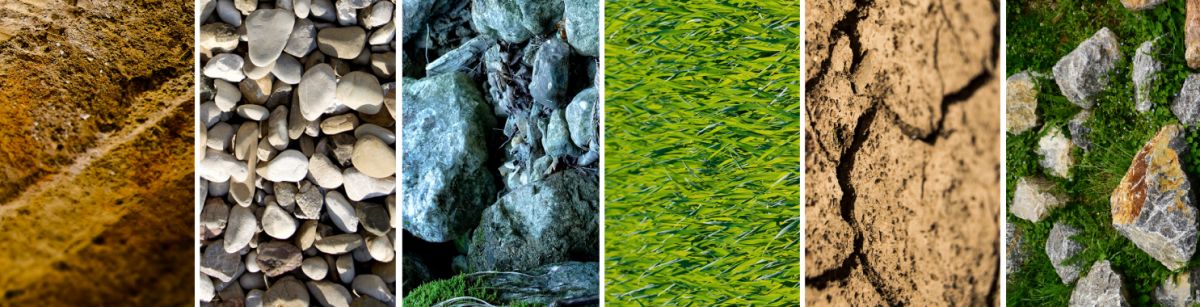
Soil type refers to different forms of soil that have developed similar characteristics in the form of soil horizons as a result of the processes of pedogenesis (soil formation) and therefore have a similar stage of development. While the soil type describes the appearance of a soil as a result of soil formation, soil types (also soil texture or grain size) are differentiated according to the grain size composition of the mineral soil substance. The main soil types are sand, silt, clay and loam.
Alberese
Italian term for weathered sandstone with a high proportion of calcium carbonate (limestone) in Tuscany, which is particularly prevalent in the central and southern part of the Chianti region. See below under limestone.
Alluvium/Alluvion (alluvial soil)
Alluvial sediment (loose material) washed up and deposited by water. Alluvium is also a term for the Holocene, the most recent geological era, which has lasted since the end of the last ice age around 10,000 years ago. Alluvial soils are fine-grained, very fertile soil types that form in the floodplains and estuaries of rivers. They consist of soil particles that have been washed up and then sedimented.
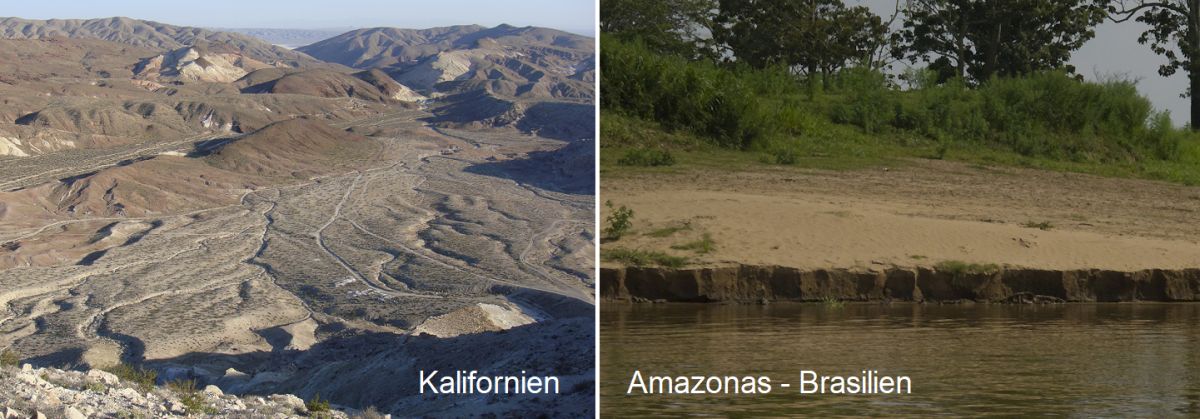
Depending on the sinking speed of the soil particles carried in the water and the flow velocity of the flood water, they consist of clayey silt, mud, sand or, in the bank area with high flow velocities and strong erosion dynamics, gravel and boulders. Despite their predominantly stony and sandy nature, as in the French Médoc region, these soils are very suitable for viticulture. The secret of the sites there are the clay lenses deposited during various floods and covered with sand and gravel in the interior of the alluvial gravel terraces, which can store water. Such clay layers are literally sought out by the vine roots in their search for water.
Amphibolite
Mostly black to grey to dark green rock formed by the metamorphic transformation of basalt (see below) under high pressure and temperature conditions. It consists of up to 50% representatives of the amphibole group, such as hornblende (see below) or chermakite, and up to 40% of other minerals such as garnet and quartz, as well as ores such as magnetite and pyrite.
Aeolian
Phenomena caused by the wind, named after the Greek wind god Aeolus. Aeolian transport causes fine material such as loess, silt or clay to be released from unconsolidated rock and transported over long distances by the wind. Aeolian weathering is the removal of rock by grains of sand and fine gravel moved by the wind with the effect of a sandblast.
arcose
The geological term describes a pink to reddish, coarse-grained sandstone with a high proportion of feldspar, which mainly occurs in dry, arid areas. It leads to the coarser-grained granite rocks.
Alluvial soils
Soils formed from river deposits that are periodically flooded. Such soils are found, for example, in the Danube, Moselle and Rhine floodplains. When they are no longer flooded, they develop into brown earths and parabrown earths. These soils are usually nutrient-rich, biologically active and fertile.
Basalt
Basic effusive rock (cooled magma) consisting of feldspar, hornblende, olivine and magnetite, which was formed during the melting of the earth's mantle. It contains a lot of lime and soda and is rich in minerals. The hard, slowly weathering rock forms good soils and produces wines with appealing acidity. It is particularly suitable for white wines made from Chardonnay, Grüner Veltliner, Pinot Blanc, Sauvignon Blanc and Welschriesling. Such soils are found on the Moselle and Middle Rhine (Germany) and in Styria (Austria).
Pumice (pumice stone, pumice tuff)
The porous, glassy volcanic rock is formed by gas-rich volcanic eruptions in which the lava is foamed by water vapour and carbon dioxide. It does not differ chemically from other lava, but is considerably lighter due to the trapped air. The colour varies from black to grey to white.
The term pumice stuff refers to the grain size with at least 75% volcanic ash. Pumice soils have a good water retention capacity and are very suitable for viticulture. It is found throughout the Greek island of Santorini, which was formed from a volcanic explosion. Obsidian is similar to pumice, but contains considerably less carbon dioxide. See also under Canava and below under Volcanic rock.
Blue slate
See below under slate.
Boulbènes
A term commonly used in Bordeaux for a very fine, siliceous soil. It is found, for example, on the plateau of the French Entre-deux-Mers region.
Brown earth
These A-B-C soils develop primarily over rocks that are rich in bases but low in lime, such as granite, gneiss, greywacke, clay slate and clayey sandstone. The formation took place under humid climatic conditions from humus-rich topsoil on low-calcium silicate rock (Ranker) with deciduous and mixed forest cover.
The characteristic brown colouration in the B horizon is caused by iron oxides, which are formed during the chemical weathering of ferrous silicates. The acids released by the tree roots contributed greatly to the deep weathering of the B horizon. The lime content, stone content and water balance of brown earths can vary greatly. Depending on its composition, this can be an excellent soil for viticulture.
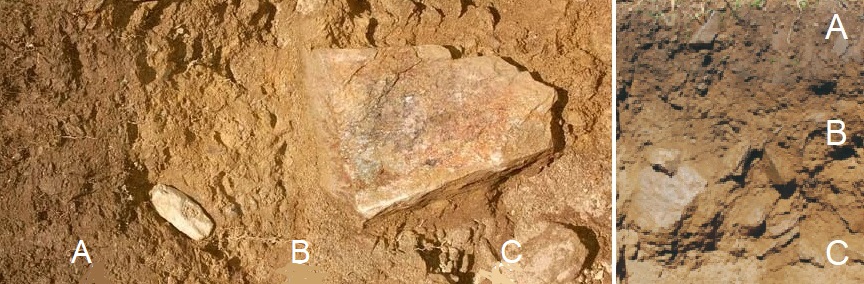
Parabrown earth differs from brown earth in that clay particles have been displaced from upper to deeper layers. This is a process that takes place during soil acidification. When lime dissolves, cementing lime structures disappear so that the released clay particles are washed away with the seepage water into deeper soil layers. Parabrown soils usually develop from pararendzines. Parabrown and brown earths are the most common soils in humid Europe. Loam and loess parabrown soils are among the most fertile soils.
Breccia (Breccie)
Conglomerate with angular components (see below).
Coloured sandstone
Multicoloured, mostly red sandstone with partly clayey alluvium. Bunter sandstone was formed from the erosion debris of Palaeozoic mountains. It was deposited in a dry, semi-desert climate in a large basin (Germanic Basin) in the centre of present-day Europe and was later overlaid by sedimentary rocks such as Jurassic limestone or airborne loess. Such soils can be found in the Palatinate growing region (Germany).
Crasse de fer
Term for a sandy-gravel soil with intermediate layers of clay and a sub-layer of ferrous ironstone in the Pomerol region; see also Terra Rossa.
Iron
See under Terra Rossa and below under Rotliegendes.
Feldspar
Complex silicate compounds of white and reddish minerals that make up about 60% of the composition of the earth's crust. They contain iron, potassium, calcium and sodium. There are three main groups: potassium feldspar (adular, sanidine), soda-lime feldspar (albite, pericline, anorthite) and microline. Weathering produces base-rich clay minerals that can release mineral-bound ions as...