The wine-growing region is located in Rhineland-Palatinate and to a small extent also in Saarland in Germany. The Moselle River winds its way from Trier to Koblenz over 237 km, but as the crow flies it is only 96 km. The vineyards cover 8,798 hectares of vines, stretching along the Moselle from its headwaters in the Vosges Mountains on the border of Luxembourg to its confluence with the Rhine near Koblenz, as well as along its two tributaries, the Saar and the Ruwer. These three rivers gave the wine-growing region the old name Mosel-Saar-Ruwer, which was valid until 2007. The oldest vineyards in Germany are located on the upper Moselle. The Romans were already cultivating vines here in the 1st century BC and founded the city of Augusta Treverorum, today's Trier, in 15 BC. Remains of old Roman presses can still be seen in Piesport and Erden. The Neumagen wine ship also points to Roman wine culture. The two Roman poets Ausonius (310-395) and Venantius Fortunatus (530-610) described the beauty of the landscape during boat trips on the Moselle. In the Middle Ages, the Benedictine order owned many vineyards along the banks of the three rivers, to which many individual vineyard names attest.
After occupying this area in 1807, Emperor Napoleon (1769-1821) passed a law whose negative after-effects can still be felt today. In order to prevent large-scale land ownership, he ordered "real division", by which land ownership was to be divided equally among all descendants in the event of inheritance. The result was a fragmentation into innumerable, often extremely small, land units. At the Congress of Vienna in 1815, the former territory of the Electorate of Trier was annexed to the Prussian state. As a result, the royal government took various measures to improve the economic situation of Moselle winegrowers. These included the Prussian site classification, the founding of the winegrowers' association and the establishment of three winegrowing domains on the Moselle and Saar, which ushered in a golden age of Moselle winegrowing. This continued the tradition of the great wine lover King Frederick the Great (1712-1786), who had already had a vineyard planted on the southern slope of the Klausberg in Sanssouci Park in Potsdam in 1769.
Climate & Soil
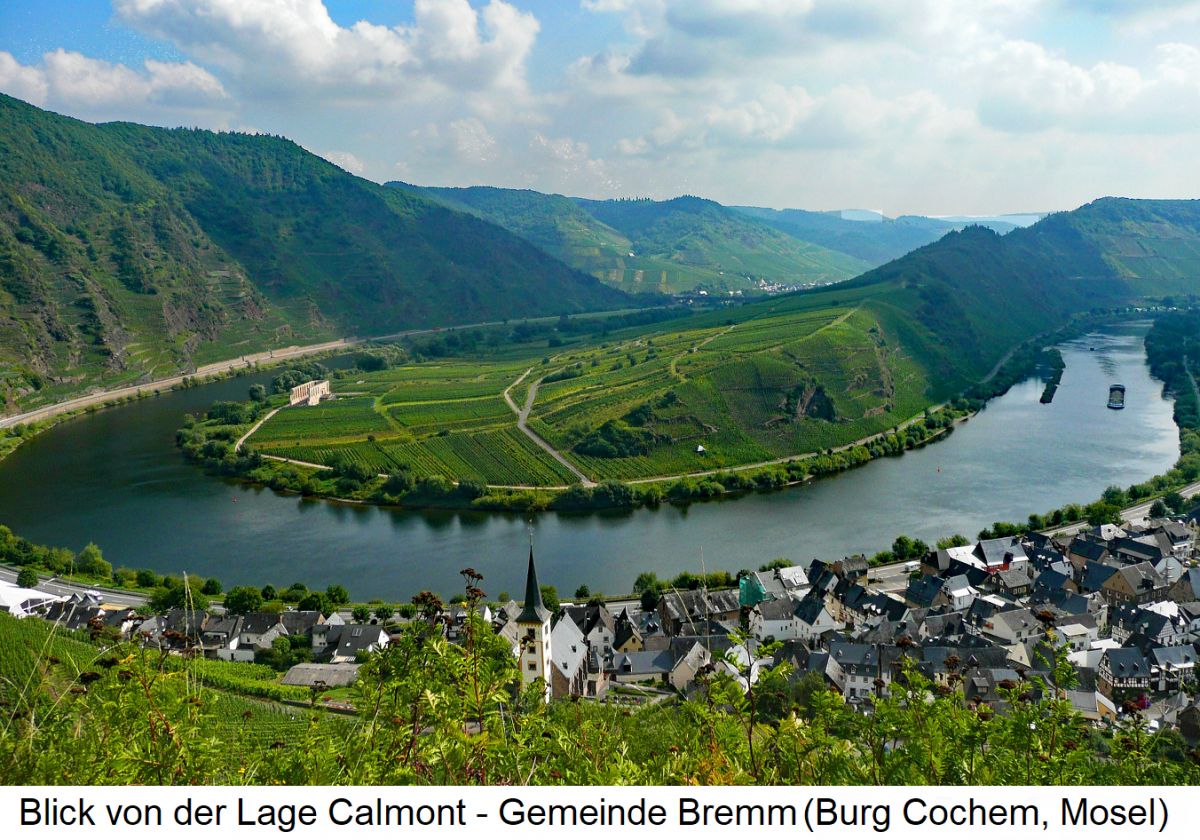
The wine-growing region belongs to the warmer climatic zones of Germany. The Moselle, like all bodies of water, exerts a positive influence or creates the conditions for this by forming valley slopes. Viticulture benefits from the ideal combination of steep, sun-drenched slopes, the sun-reflecting slate soils and optimal rainfall. In some steep slopes, cultivation is only possible using special equipment and monorack tracks. Calmont is one of the steepest vineyards in the world, with a slope of up to 68°. Due to the heat storage, frosts are largely prevented. There are only slight temperature fluctuations. As a rule, there are pleasantly warm summers and only moderately cold winters. The soils on the upper course of the Moselle consist of shell limestone and Keuper, and on the middle and lower course of the Moselle and in the valleys of the Saar and Ruwer of Devonian and clay slate. The dark clay slate is found in about half of the vineyards.
The slate stores the sun's heat during the day and releases it again at night, which makes for a mild climate. The vines are usually rooted metres deep in the soil or rock. Many small winegrowers work the often terraced steep slopes in painstaking manual labour and deliver their grapes to large wineries. Mosel is divided into six areas with 19 large vineyards and 524 individual vineyards. The 242-kilometre-long Moselle Wine Route begins directly behind the German-French border in Perl, runs along the river and crosses it several times. Along the way, it touches many famous wine-growing communities and finally ends in Koblenz.
Areas, municipalities and sites
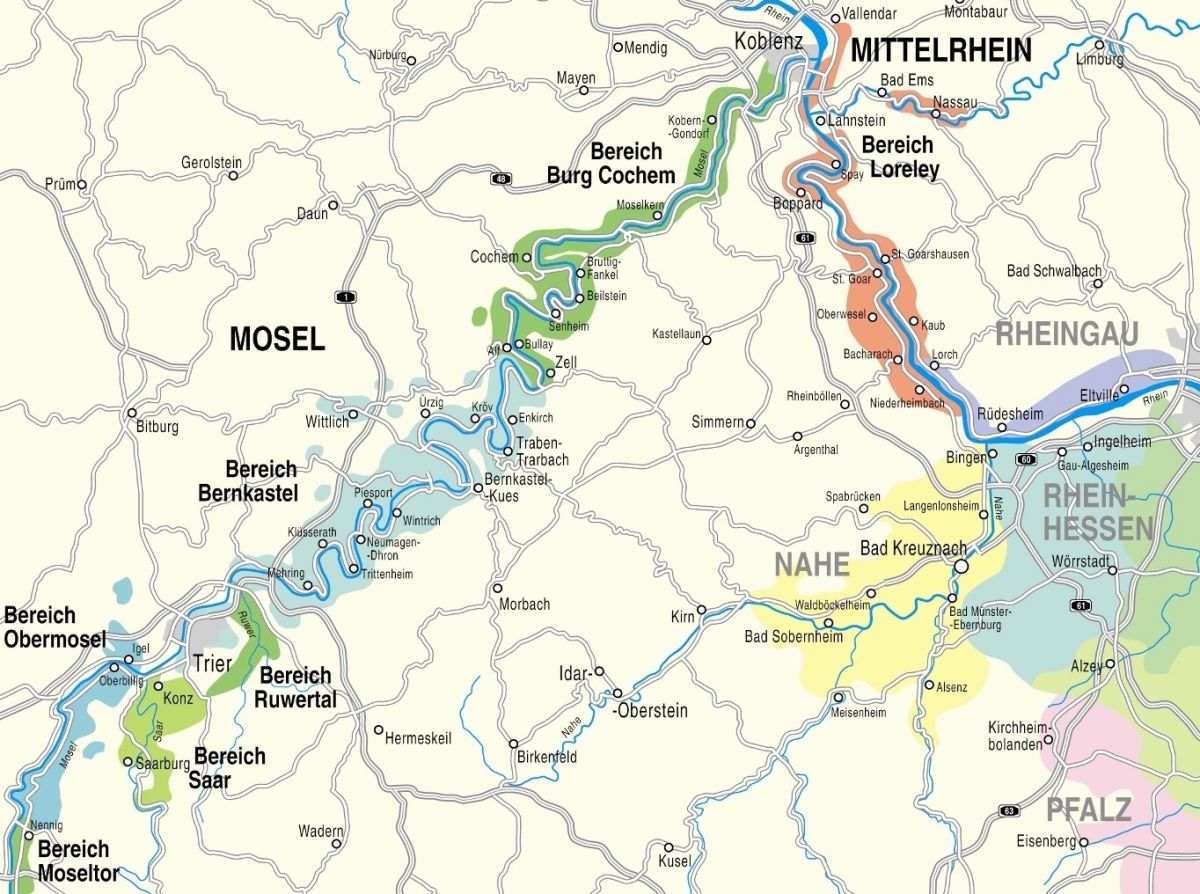
German wine law allows the area name to be used on the label without the addition of "Bereich" (area), as long as there are no place names or single vineyard designations with which confusion could arise. The winegrowers from the "Saar" had already practised this from the time of the name change, but this was not possible for those on the "Ruwer". In 2019, vineyards with the name part "Ruwer" in the district of Trier-Ruwer, which are no longer cultivated, were deleted from the vineyard register, thus making it possible to cite them on the label.
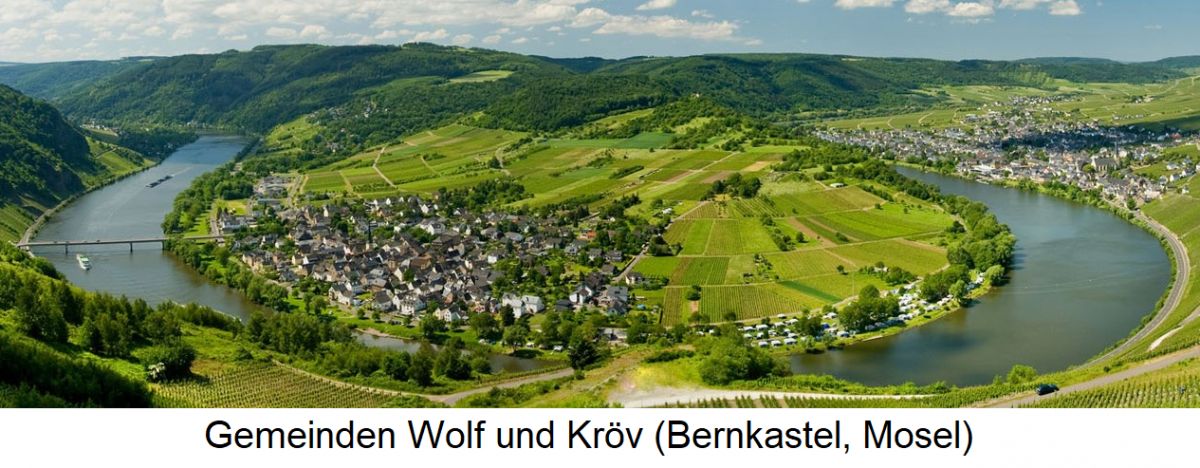
The area Bernkastel or Mittelmosel (formerly Untermosel) is the heart of the region with the most vineyards. It stretches from Briedel in the north upstream to the Moselle metropolis of Trier in the south, a distance of about 50 kilometres. The Moselle flows through the area in ten relatively narrow loops. The large area covers almost 6,000 hectares of vineyards and is divided into ten major vineyards: Badstube, Kurfürstlay, Michelsberg, Münzlay, Nacktarsch, Schwarzlay, St. Michael, Probstberg, Römerlay and Vom heißen Stein. The most famous Moselle communities and vineyards are located here. One of the most famous single vineyard sites in the area and also in Germany is Bernkasteler Doctor. It belongs to the renowned Großlage Badstube with (unusually) only first-class sites. For the most part, the deep soils consist of dark blue weathered Devonian slate with often high stone content; in the municipality of Ürzig there is also Rotliegendes (red sandstone). The best-known wine-growing communities with their individual vineyards:
- Avelsbach: Altenberg, Hammerstein, Herrenberg, Kupp, Rotlei
- Bernkastel Old bathhouse on Doctorberg, Bratenhöfchen, Doctor, Graben, Johannisbrünnchen, Kardinalsberg, Lay, Matheisbildchen, Rosenberg, Schlossberg, Stephanus-Rosengärtchen, Weisenstein
- Brauneberg Juffer, Juffer Sonnenuhr, Kammer, Klostergarten, Mandelgraben
- Briedel: Herzchen, Nonnengarten, Schäferlay, Schelm, Weisserberg
- Castles: Bischofstein, Hasenläufer, Kirchberg, Römerberg
- Detzem: Maximiner Klosterlay, Würzgarten
- Enkirch: Batterieberg, Edelberg, Ellergrub, Herrenberg, Monteneubel, Steffensberg, Weinkammer, Zeppwingert
- Erden: Bußlay, Herrenberg, Prälat, Treppchen (Herzlei)
- Graach: Abtsberg, Domprobst, Himmelreich, Josephshöfer
- Kesten: Herrenberg, Paulinsberg, Paulinshofberger
- Kinheim: Hubertuslay, Römerhang, Rosenberg
- Klotten: Brauneberg, Coreidelsteiner Castle, Rosenberg
- Klüsserath: Brotherhood
- Köwerich: Held, Laurentiuslay
- Kröv: Burglay, Herrenberg, Kirchlay, Letterlay, Paradies, Steffensberg
- Leiwen: Monastery garden, Laurentiuslay
- Lieser: Niederberg-Helden, Rosenlay, Schlossberg, Süßenberg
- Longuich: Herrenberg, Hirschlay, Maximiner Herrenberg
- Lösnich: Burgberg, Försterlay
- Maring-Noviand: Honigberg, Klosterberg, Lambertuslay, Roman path, Sundial
- Mehring: Blattenberg (with cadastral site Layet), Goldkupp, Zellerberg
- Mülheim: Amtgarten, Elisenberg, Helenenkloster, Sonnenlay
- Neumagen-DrohnEngelgrube, Großer Hengelberg, Häs'chen, Hofberger, Laudamusberg, Nußwingert, Rosengärtchen, Sonnenuhr
- Piesport: Domherr, Falkenberg, Gärtchen, Goldtröpfchen, Grafenberg, Günterslay, Hofberger, Kreuzwingert, Schubertslay, Treppchen
- Pölich: Held
- Pünderich: Goldlay, Marienburg, Nonnengarten, Rosenberg
- Reil: Falklay, Goldlay, Mullay-Hofberg, Sorentberg
- Thörnich: Enggaß, Ritsch, Schießlay
- Treis: Greth, Kapellenberg, Treppchen
- Trier: Altenberg, Andreasberg, Augenscheiner, Benediktinerberg, Burgberg, Deutschherrenberg, Deutschherrenköpfchen, Herrenberg, Jesuitenwingert, Kupp, Kurfürstenhofberg, Rotlei, St. Martiner Hofberg, St. Martiner Klosterberg, St. Matheiser, St. Maximiner Kreuzberg, St. Petrusberg, Thiergarten Felsköpfchen, Thiergarten Unterm Kreuz
- Traben-Trarbach: Burgberg, Gaispfad, Goldgrube, Hühnerberg, Klosterberg, Königsberg, Kräuterhaus, Kreuzberg, Schatzgarten, Schlossberg, Sonnenlay, Taubenhaus, Ungsberg, Würzgarten, Zollturm
- Trittenheim: Altärchen, pharmacy, Felsenkopf, Leiterchen
- Ürzig: Goldwingert, Würzgarten (Kranklei, Sundial)
- Veldenz: Carlsberg, Elisenberg, Grafschafter Sonnenberg, Kirchberg, Mühlberg
- Wehlen: Abbey, Hofberg, Klosterberg, Nonnenberg, Rosenberg, Sundial
- Wintrich: Geierslay, Großer Herrgott, Ohligsberg, Stefanslay
- Wittlich: Bottchen, Felsentreppchen, Klosterweg, Kupp, Lay, Portnersberg, Rosenberg
- Wolf: Auf der Heide, Goldgrube, Schatzgarten, Sonnenlay, Klosterberg
- Zeltingen: Deutschherrenberg, Himmelreich, Schlossberg, Sonnenuhr
The Burg Cochem (formerly Zell) area is also called the Terrassenmosel, after the many terraced slopes. It stretches along the lower Moselle from Koblenz to Zell and is divided into five major vineyards: Goldbäumchen, Grafschaft, Rosenhang, Schwarze Katz and Weinhex. The landscape is characterised by many medieval castles. The vineyards...