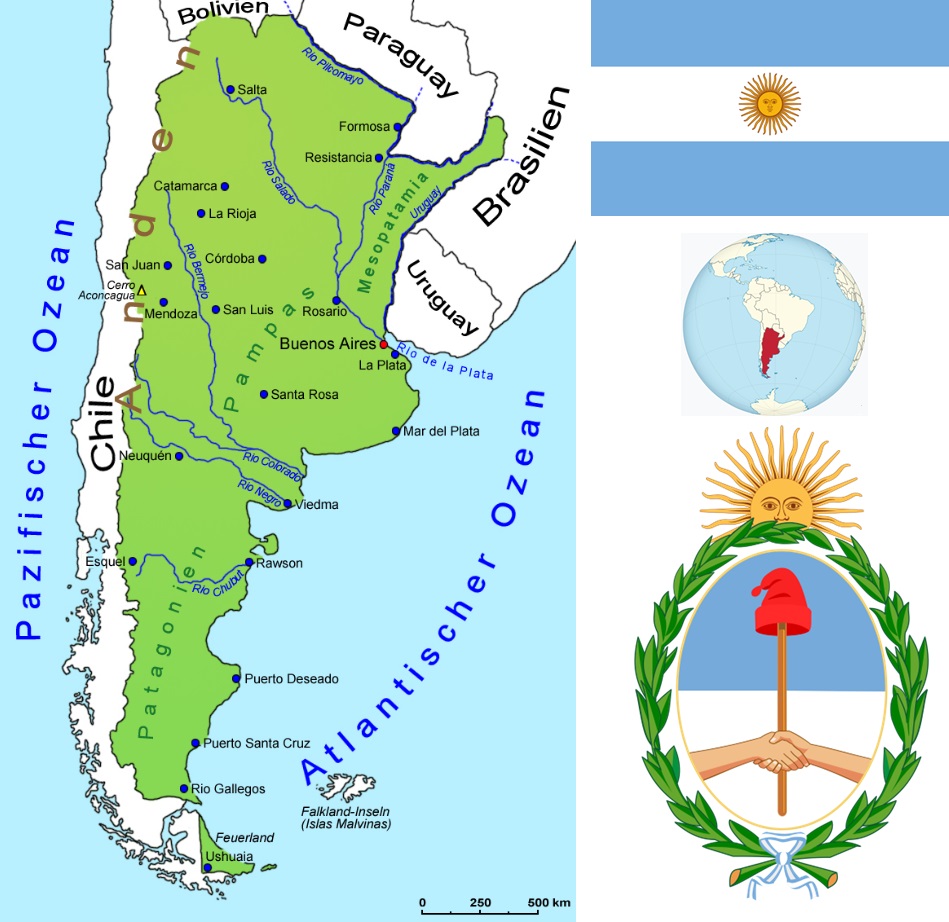
The presidential Republic of Argentina in the south of South America with the capital Buenos Aires covers 2,780,400 km². It borders Chile to the west, Bolivia and Paraguay to the north, Brazil and Uruguay to the north-east and is bordered by the Atlantic Ocean to the east. Until its independence in 1816, it was part of the Spanish colonial empire.
History
In 1541, Spanish conquistadores planted vines at the mouth of the Rio de la Plata on the Atlantic coast, but without success. Argentinian viticulture began with the production of mass wine. The citizens of the northern city of Santiago del Estero in the province of the same name built a church and looked for a priest.
The Jesuit priest Cedrón, who arrived with the conquistadores from Spain, travelled from the other side of the Andes from Chile and brought cotton seeds, wheat, barley and some European grape varieties with him as a gift, including the historically important Listán Prieto, which is known here as Criolla Chica, Uva Negra or Uva Negra Vino (see also under Criolla). These vines were planted from 1556 in the three provinces of La Rioja, Mendoza and San Juan. By the end of the 16th century, commercial viticulture had already developed in some of these areas.
Viticulture in modern times
Don Tiburcio Benegas (1844-1910), who founded the Trapiche winery in Godoy Cruz in 1883 and successfully experimented with European and Chilean vines, is considered the founder of Argentinian viticulture in modern times. His father-in-law Don Eusebio Blanco had written the book "Las viñas y los vinos de Mendoza" in 1872 as the first fundamental work on Argentinean viticulture. In 1853, the French agronomist Michel Aimé Pouget (1821-1875) was commissioned by the Argentinian president Domino Faustino Sarmiento (1811-1888) to introduce suitable vines.
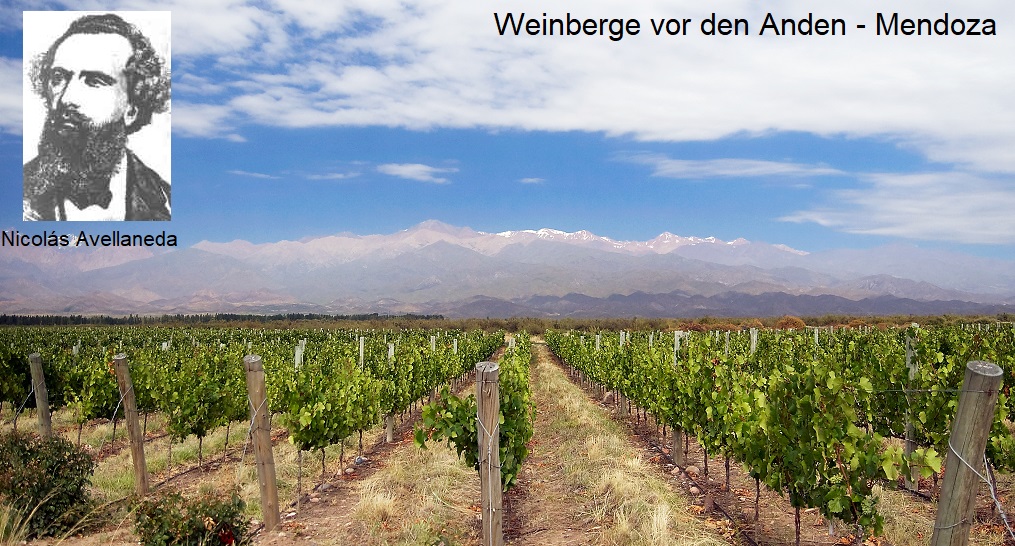
The Malbec (Cot) variety proved to be particularly suitable and is the leading variety in terms of quantity. In the first half of the 18th century and towards the end of the 19th century, there were two large European immigration flows from Italy, Spain and France, as residence permits were greatly simplified at the initiative of the politician Nicolás Avellaneda (1837-1885). These emigrants gave viticulture a hugely positive boost. At the beginning of the 20th century, oenologist Leopoldo Suárez Zapata (1882-1932) introduced European vines to Mendoza on a large scale.
Regions & growing areas
The highly fragmented vineyards stretch from Salta in the north to Chubut in the south. In the west, they form a strip 1,750 kilometres long and 100 kilometres wide along the foothills of the Andes. The altitude of 600 to 1,200 metres above sea level on average and up to 2,400 metres in some places results in cool night-time temperatures. The Colomé winery in Salta even cultivates vines at an altitude of 3,111 metres, making it the highest vineyard in the world.
Due to low rainfall averaging 200 to 250 mm per year with relatively frequent hail, low humidity and high drought (with the advantage of rare fungal diseases), artificial irrigation is essential. This is done mainly through a network of canals, which was started centuries ago by the indigenous people. The water comes from rivers carrying meltwater with their springs in the nearby Andes, as well as from thousands of deep...