
See under ripening time.
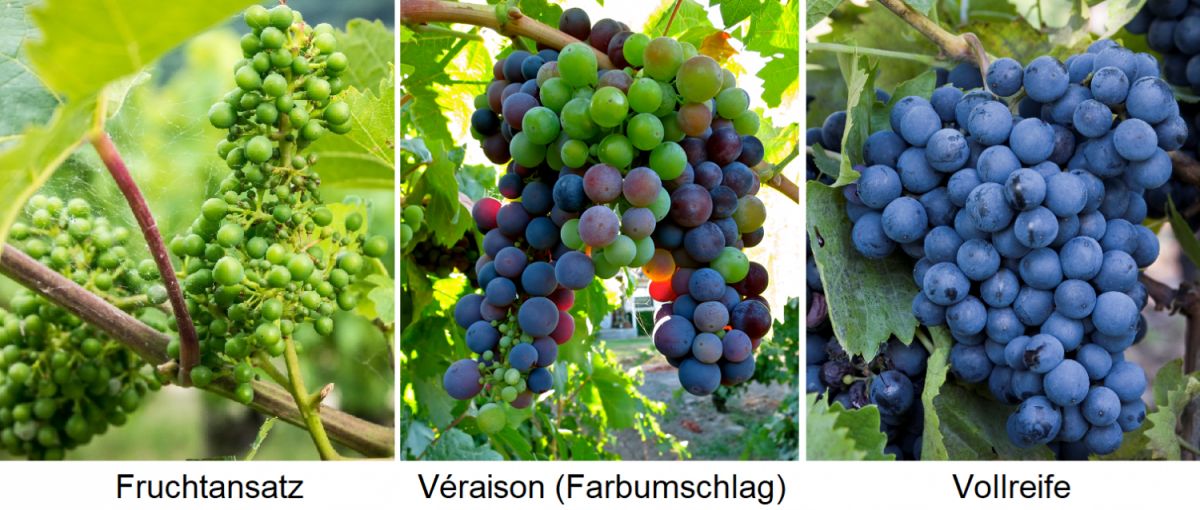
After fertilisation during flowering, the individual grape berries begin to grow very quickly. The acid concentration in the unripe berries rises to a maximum value, then it is reduced and the sugar content increases rapidly. At this point, the ripening phase known as véraison begins within the annual vegetation cycle of the vine, after which the berries become soft and begin to discolour.
The end of the ripening phase or peak of maturation is characterised by an optimal ratio of sugar to acidity (see physiological ripeness and engustment). The time between flowering and ripening varies greatly depending on the grape variety, which is why we speak of early, medium and late ripening grape varieties. Soil type, climate, weather and the work of the winegrower also have an influence on this. The time of ripening also depends on the microclimate in the vineyard and can also differ between individual clones of the same grape variety. Even in smaller vineyards, the same grape variety can therefore produce different results.

The development of a grape: 1 = fruit set, 2 = Véraison, 3 = full ripeness (physiological ripeness, engustment).
Grape varieties are often only roughly categorised as early, medium and late (northern hemisphere):
![]()
There is a vast number of sources on the web where one can acquire knowledge about wine. But none has the scope, timeliness and accuracy of the information in the encyclopaedia at wein.plus. I use it regularly and rely on it.
Sigi Hiss
freier Autor und Weinberater (Fine, Vinum u.a.), Bad Krozingen