As a rule, at least 25-year-old vines are considered "old". The age is often used by producers for advertising purposes to indicate a special quality. This is indicated on the label by designations such as "old vines" or French "vieilles vignes". Many French appellation regulations state that no vines under three years old may be used. Many major wineries in France only use vines with self-imposed minimum ages for Grand Vins. However, there is no generally valid minimum age, the term is used in different ways and also has no meaning in wine law. Sometimes it is also understood to mean ungrafted (ungrafted) vines.
Age and yield
After new vines have been planted, the maiden harvest or the pressing of the maiden wine takes place after three to five years at the earliest. The age of a vine has an effect on the wine quality; one often hears the catchphrase "the older, the better". Normally, vigour and yield begin to decline steadily at around 20 years of age and a vine becomes uneconomical at around 50 years of age. In general, vineyards in Central Europe hardly live more than 25 to 30 years, then they are mostly replaced due to lower yields. Slowly, however, a certain trend reversal can be observed. More and more wineries are cultivating vines with a respectable age of 50, 60, 70 and in some cases even more than 100 years on smaller areas. The wines made from these vines are mostly produced in small quantities.
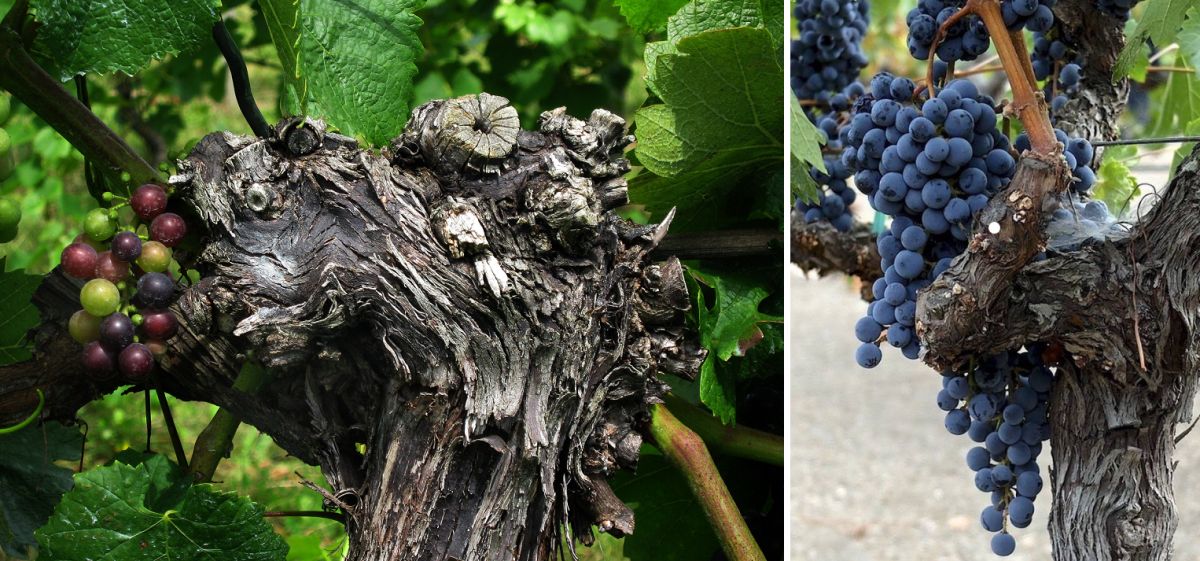
Wines from these vines tend (but not in principle) to be of better quality. One of the reasons is the lower yield, but this should not be overestimated. Because some other factors also play a role, such as the better, more intensive exposure (sunlight) due to lower growth of foliage and fruit. Likewise, the extensively branched root system of old vines has a positive effect, although root activity decreases with age. Quality is the complex interaction of grape variety, location (terroir) and yield. However, there is also the phenomenon that some vineyards produce the best wine qualities in the first two to three years of yield. The reason for this is, among other things, an optimal relationship between foliage and fruit. However, this is clearly the exception and can also be achieved in older vineyards through appropriate foliage management.
Record list of very old vines
The following is a list of vines and vineyards in Europe and overseas that are up to 500 years old. However, this list does not...