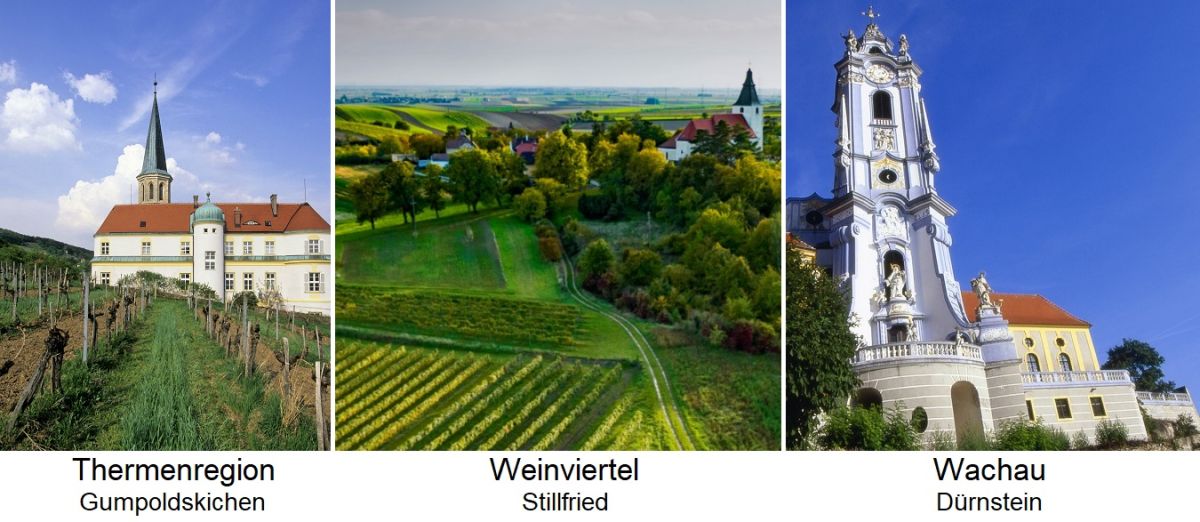
The federal state of Lower Austria, whose capital St. Pölten (until then Vienna) was elected by referendum in 1986, is located in the east of Austria. With an area of around 19,200 km², it is the largest federal state. It surrounds Vienna, borders the Czech Republic to the north, Slovakia to the north-east and, within Austria, Burgenland to the south-east, Styria to the south and Upper Austria to the west.

Even before the soldiers of Emperor Marcus Aurelius Probus (232-282) brought wine presses to the Danube, the indigenous people were already pressing Marcomanni wine. The municipality of Stillfried an der March in the Weinviertel is one of the most important archaeological sites in Austria and, along with Zagersdorf in Burgenland, is considered the oldest wine-growing village in Central Europe. Several important artefacts are on display in the Stillfried Museum. These include the "Stillfried Cup", a bronze drinking vessel and grape seeds from a Vitis vinifera around 900 B.C. At this time, the Celts settled in this area, who were already growing grapes and using wooden barrels to transport wine.
![]()
wein.plus is a handy, efficient guide to a quick overview of the colourful world of wines, winegrowers and grape varieties. In Wine lexicon, the most comprehensive of its kind in the world, you will find around 26,000 keywords on the subject of grape varieties, wineries, wine-growing regions and much more.
Roman Horvath MW
Domäne Wachau (Wachau)