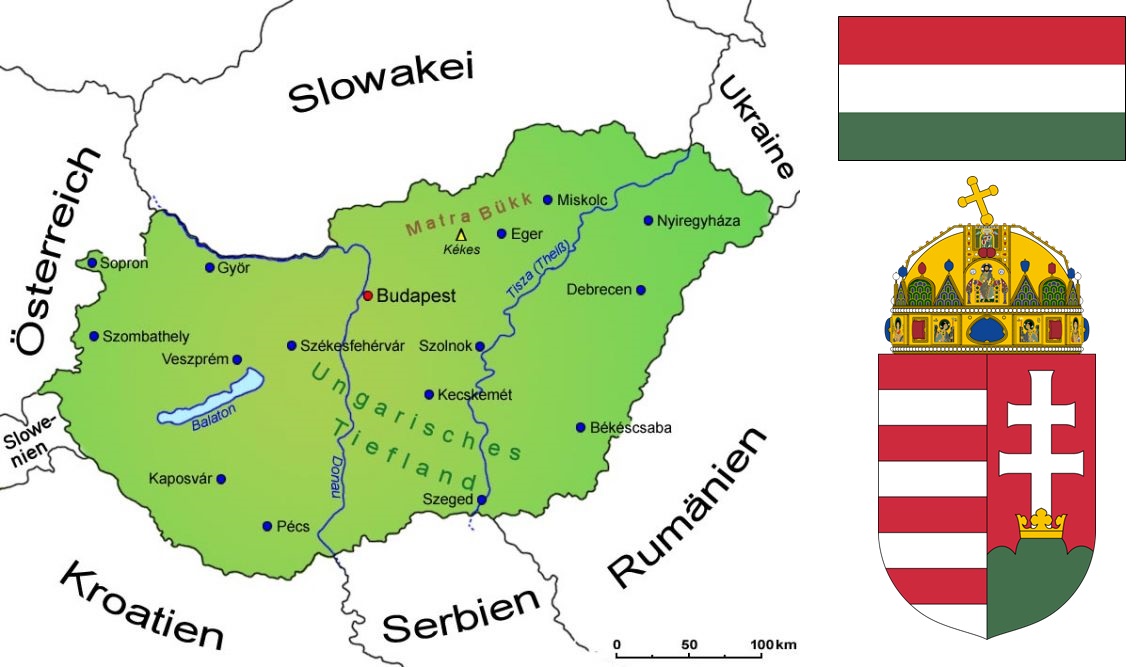

The parliamentary republic of Hungary (Hungarian: Magyarország) in Central Europe with the capital Budapest covers 93,036 km². The country located in the Pannonian Basin and traversed by the Danube borders to the north with Slovakia and Ukraine, to the east with Romania, to the south with Serbia and Croatia, and to the west with Slovenia and Austria. As one of the first Eastern Bloc states, Hungary became a democracy in 1989.

Hungary has a very old wine culture, as wines from Sopron and Eger were already known in the 13th century. Wine cultivation in the Carpathian Basin was influenced by ancient Central Asian traditions and Roman wine culture. Despite wars and unrest, wine has been cultivated here for over 1,000 years. Even the Ottomans, who occupied most of the country for about 160 years, did not suppress wine cultivation despite alcohol prohibition due to tax revenues, but development was hampered during this time. According to a tradition, Emperor Charlemagne (742–814) was so enthusiastic about "Avar wine" that he had some wine vine brought to Germany.
![]()
Serious sources on the internet are rare - and Wine lexicon from wein.plus is one such source. When researching for my articles, I regularly consult the wein.plus encyclopaedia. There I get reliable and detailed information.
Thomas Götz
Weinberater, Weinblogger und Journalist; Schwendi