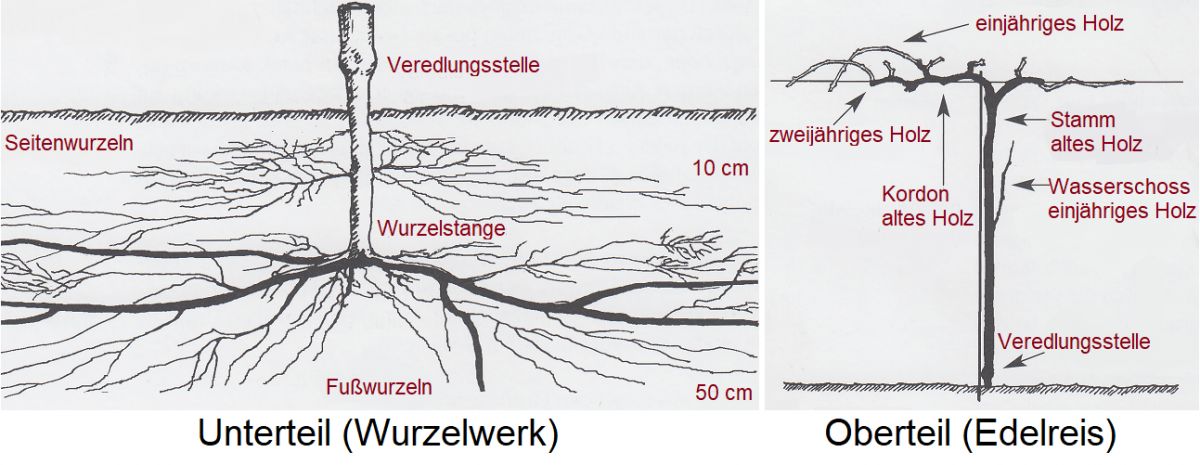
Term (also grafting, copulation, variegated pelting) for the artificial, vegetative propagation of woody plants. This is most common with rose and fruit varieties. In principle, it is a transplantation of a plant part (scion) onto the root part of another plant (rootstock). The process can also be called cloning, because it produces genetically completely identical new plants from the original plants. This technique was already known in antiquity, especially for fruit and olive varieties, and is also mentioned by Cato the Elder (234-149 BC) for vines. The main aim is to preserve special characteristics, especially of fruit-bearing original varieties but also ornamental plants, if their preservation is endangered by poor or disease-prone root systems, unsatisfactory growth vigour (too strong, too weak) or incompatibility with the soil (e.g. lime).
Reason for grafting - phylloxera
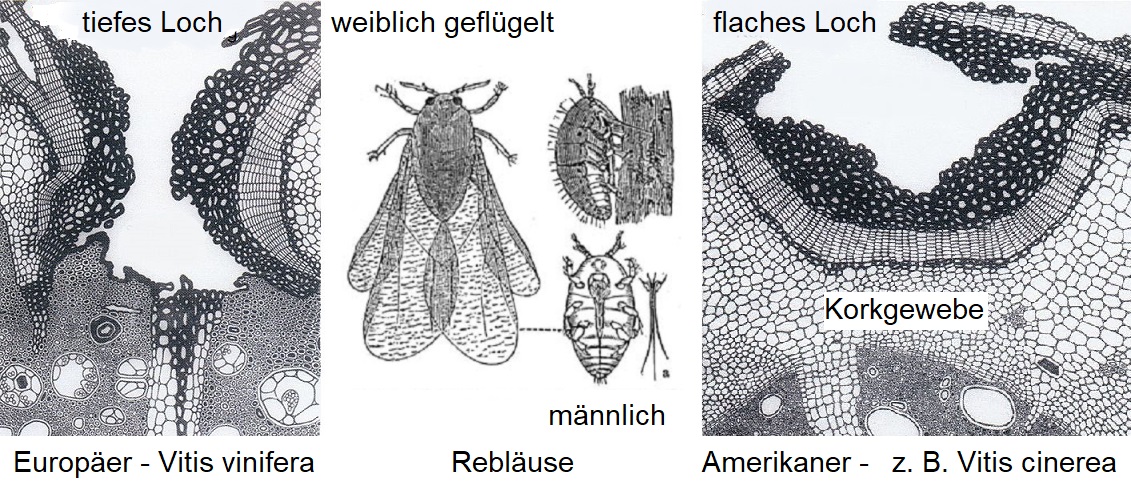
The reason for the worldwide grafting of grapevines was phylloxera, which was introduced from America in the middle of the 19th century. In the complex life cycle of the pest, the leaves are attacked above ground and/or (what is much more dangerous) the roots below ground. The vines react as a defensive reaction by forming galls (leaves) or growths (roots), which are used by the phylloxera as food. The growths on the roots are called nodosities (on young, unwoody roots) and tuberosities (on old roots). Some of the American grapevine species are resistant to varying degrees. Phylloxera resistant species develop little to no growths on the roots. The picture shows a European grapevine with a hole-like depression extending far into the interior and a phylloxera-resistant American grapevine where the phylloxera attack is followed by sealing off by cork tissue.
The solution to the problem
After numerous failed attempts with partly absurd ideas, we finally came up with the saving idea. European scions were grafted onto the rootstocks of selected American vines. The American species Vitis berlandieri (high lime tolerance, resistant to phylloxera at the root), Vitis rupestris, Vitis riparia and the particularly phylloxera-resistant Vitis cinerea are resistant. As early as the end of the 19th century, crosses were therefore made between various American species, but also with the European Vitis vinifera, and rootstocks were selected from these. Ideally, they are not only resistant to phylloxera and nematodes (threadworms), but are also suitable for various soil types and harmonise with the growth characteristics of the respective scion (top).
The character of the new vine is determined solely by the grafted grape variety, as the genetic material of the scion is not mixed with that of the rootstock, but remains unchanged. The rootstock, which is foreign to the species or variety, "only" serves to anchor the grapevine to the growing site, to absorb water and nutrients from the soil and to defend the grapevine against subterranean stages. This is in contrast to the breeding of new grape varieties, which have half the characteristics of both parent varieties in a new combination. The different...