The name of the widely ramified and highly influential Rothschild family empire is inextricably linked with the European banking and economic history of the last 200 years. In viticulture, members of the Rothschild family are also well known for their ownership of two of the most famous châteaux in the French commune of Pauillac in the Médoc. These are the two wine estates classified as Premier Grand Cru Classé, Château Lafite-Rothschild (French branch) and (only later) Château Mouton-Rothschild (English branch). Both the close relationship and the proximity of the two neighbouring vineyards have resulted in close links and a shared history for over 200 years.
There has always been open rivalry between the two long before the Rothschild families took over (Mouton in 1853 and Lafite in 1868). One of the first causes of conflict was the fight over the "Les Carruades" property, which is located right on the border between the two wine estates. In 1845, a fierce dispute broke out between the two wine estate administrators over the property, which was then decided in favour of Château Lafite.
BORDEAUX CLASSIFICATION 1855
The second major cause of conflict ten years later was the famous Bordeaux classification carried out in 1855, in which Lafite was classified as a Premier Grand Cru and Mouton only as a Deuxième Grand Cru. Mouton refused to accept this "dishonour" from the outset and Lafite savoured the triumph.
The third reason occurred in 1953, when Elie Robert de Rothschild (1917-2007), as the owner of Lafite, initiated the exclusion of Mouton from the "Association of Five" (the four Premiers at the time and Mouton) on the grounds that it was not a Premier Cru. The endeavour to elevate Mouton to the first rank was not supported by Lafite, in fact it was vehemently opposed. It is a joke that during the German occupation, the two wine estates were confiscated by the Vichy government in 1942 and run jointly.
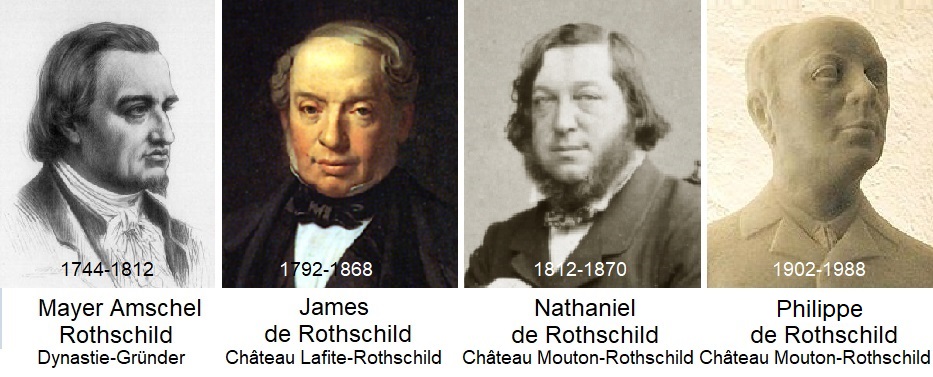
On behalf of his father Mayer Amschel Rothschild (1744-1812), Jakob Mayer Rothschild (1792-1868) settled in Paris in 1812, where he changed his first name to James. Here he founded the French bank branch in 1817. In 1822, he and his four brothers were awarded the hereditary title of "Baron" by Emperor Franz I (1768-1835) of Austria. In 1868, he bought the "Château Lafite" and added the family name "Rothschild".
However, he probably never saw his property, as he died in the same year. His three sons Gustave, Edmond and Alphonse left the management to a managing director and their children were also only shown the balance sheet each year. Although Edmond de Rothschild (1845-1934) revitalised viticulture in Palestine (now Israel) in 1882 with a donation of 60 million gold francs, he also paid little attention to the property in France.
Elie Robert de Rothschild
His great-grandson ElieRobert de Rothschild (1917-2007) served as an Allied soldier in the Second World War and was a leading figure in the family bank after his return. He also converted the former Paris-Lyon-Marseille railway company into a travel group with hotels and restaurants. In 1946, he took over the management of Château Lafite-Rothschild and was the first member of the family to become personally involved in the wine business. He always regarded Château Mouton-Rothschild as hostile competition and disparagingly referred to it as "this Deuxième Cru", alluding to the fact that it was not classified as a Premier Grand Cru until 1973.
Eric de Rothschild
In 1974, his fifth-generation nephew Eric de Rothschild(*1940) took over the reins. He studied engineering at the University of Zurich (ETH) and managed the family bank in Paris....