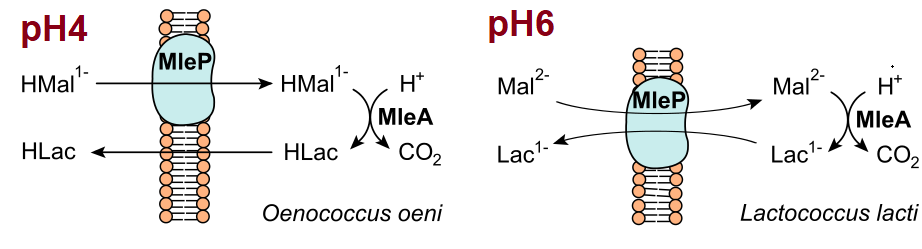

Term (biological acid degradation) for the process following alcoholic fermentation or possibly already started during this process, especially in red wine production; see malolactic fermentation.
Term for the conversion of malic acid into the milder lactic acid (Latin malum = apple, lac = milk), which plays an alternative role in the production of fruit juice, wine and sparkling wine. The process is also known as biological acid degradation (BSA), bacterial malic acid degradation, microbial acid degradation or malolactic acid fermentation. However, this is not a true alcoholic fermentation, but a fermentation in the broader biological sense. Although carbon dioxide is also released during this process, there is no conversion of sugar into alcohol. Around 1890, Dr Hermann Müller-Thurgau (1850-1927), who was working in Geisenheim at the time, correctly suspected bacteria - and not yeasts - as the cause. Dr Wenzel Seifert (1862-1942) was able to identify the acid-degrading bacterium at the Klosterneuburg Viticulture Institute in 1903 and named it "Micrococcus malolacticus".

This natural process can take 10 to 40 days. It is initiated spontaneously from around 16 °Celsius by existing or added bacteria (Oenococcus oeni). However, the process can also be started by stirring...
![]()
Using the encyclopaedia is not only time-saving, but also extremely convenient. What's more, the information is always up to date.
Markus J. Eser
Weinakademiker und Herausgeber „Der Weinkalender“