
wein.plus
Attention
You are using an old browser that may not function as expected.
For a better, safer browsing experience, please upgrade your browser.


You can also use our powerful search function with many flexible filters, such as:

Log in Become a Member

Curly Disease

See under mites.

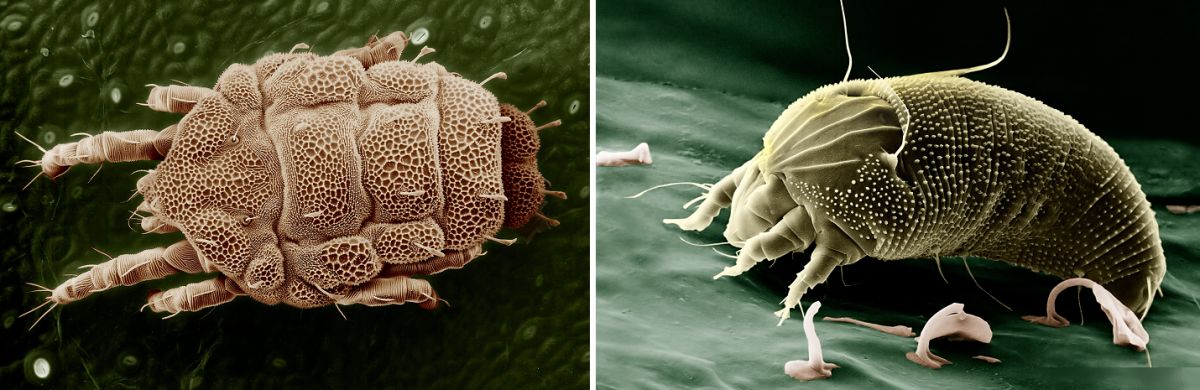
The mites (Acari) are a subclass of arachnids (Arachnida) in the phylum Arthropoda, which also includes ticks. With over 50,000 known species in well over 500 families, they are the most diverse group of arachnids. The insects, which range in size from 0.1 mm to 3 cm in ticks, have a cylindrical, spherical or disc-shaped body in many colours with four pairs of legs (often only three in the larval stage). Depending on the species, the life cycle consists of up to four developmental stages: egg, larva, nymph and adult. All active stages (except the eggs) can cause feeding damage and the resulting consequences on the plants.

Parasitic herbivores

In contrast to other arachnids, which are mostly predators, mites (Fig. 1) are mostly herbivores or live parasitically on plants or animals. The pictures show a mass infestation of a dung beetle (picture 2) and a weaver beetle infested with mites (picture 3). They are often also useful, as they play an important role in soil formation by feeding on animal or plant residues. A distinction is made between the groups of gall mites (Tetrapodili, tiny at 0.15 mm) and spider mites (Tetranychidae, up to 0.5 mm).

Milben - Milbe, auf Mistkäfer und auf Weberknecht

Pest species

The most important and most dangerous pests on vines include the four species of pox mite or leaf gall mite (Eriophyes vitis), curl mite (Calepitrimerus vitis), red spider mite or fruit tree spider mite (Panonychus ulmi) and common spider mite or bean spider mite (Tetranychus urticae).

Smallpox mite (leaf gall mite)

The smallpox mite or leaf gall mite (Colomerus vitis) is found worldwide. It is only about 0.1 to 0.2 mm in size and has an elongated, worm-like, whitish to yellowish coloured body. It mainly attacks the leaves of vines, where it causes galls (pox) or blisters (Fig. 4). Fine, felt-like webs can form on the underside of the leaves (see under Felt Disease). The mites live in these protective webs. Heavy infestations impair...

Voices of our members

Dr. Christa Hanten

For my many years of work as an editor with a wine and culinary focus, I always like to inform myself about special questions at Wine lexicon. Spontaneous reading and following links often leads to exciting discoveries in the wide world of wine.

Dr. Christa Hanten
Fachjournalistin, Lektorin und Verkosterin, Wien

The world's largest Lexicon of wine terms.

26,671 Keywords · 47,064 Synonyms · 5,303 Translations · 32,002 Pronunciations · 241,724 Cross-references
made with by our author Norbert F. J. Tischelmayer. About the Lexicon

EVENTS NEAR YOU

PREMIUM PARTNERS

wein.plus

Your approval is required –
if you are not a Premium Member

Read with advertising

... or become a Premium Member

Enjoy wein.plus without advertising and tracking by third parties!

Already wein.plus–Premium Member?