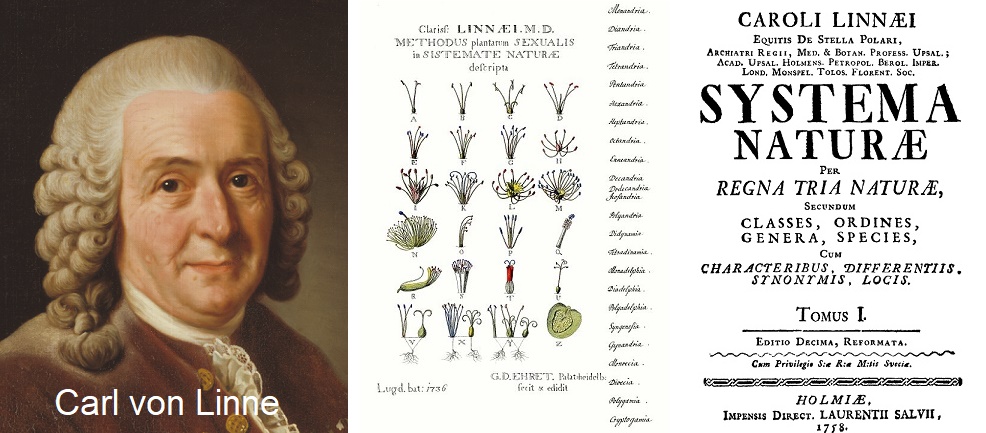

The Swedish botanist Carl von Linné (1707-1778) developed the foundations of modern taxonomy; see there.
A taxonomy (táxis = order, nómos = law) is a standardised procedure or model (classification scheme) with which objects are classified according to certain criteria and arranged in categories or classes.
In biology (the science of living things), living things are categorised hierarchically into groups according to their natural relationship, whereby six main categories are distinguished. These are animals (Animalia), plants (Plantae), fungi (Fungi), protists (Protista), bacteria (Bacteria) and archaea (Archaea). Viruses are not classified as living organisms as they do not have their own metabolism, cannot reproduce independently and do not exhibit any life processes outside a host cell (which they usually destroy).
This categorisation into a hierarchical system is traditionally associated with the classification into certain ranks, which comprise species, genus and family in ascending order. The first attempts were made in ancient times, for example by the Greek naturalist Theophrastus (370-287 BC). He classified plants, including vines, according to external characteristics such as leaf shape, fruit characteristics and growth habit.

The Swedish botanist Carl von Linné (1707-1778) developed the foundations of modern taxonomy and introduced the concept of species into biological systematics. In...
![]()
The wein.plus encyclopaedia is a comprehensive, well-researched reference work. Available anytime and anywhere, it has become an indispensable part of teaching, used by students and myself alike. Highly recommended!
Dominik Trick
Technischer Lehrer, staatl. geprüfter Sommelier, Hotelfachschule Heidelberg