
Term for the water that a soil can hold or bind with its pores against the force of gravity. See under water retention capacity.
Water storage capacity is one aspect of the complex process of plant water balance. Other components are water extraction and water stress (see there in detail).
For optimal growth, vines require soils with good water storage capacity and a constant, but not excessive, water supply. A soil with this characteristic can store water efficiently and release it slowly, which enables even irrigation and reduces the risk of drought stress. The essential water seeps into the soil after precipitation (rain, hail, sleet, snow).
A small proportion also comes from surface precipitation formed by condensation (dew, frost), which is absorbed directly by the dew roots located just below the surface. The non-solid soil substance consists of pores of different sizes that are filled with air and/or water. The pores can make up around one third to two thirds (30-60%) of the total volume. The porosity - the ratio of the void volume to the total volume - depends on the pore volume. In dry soil, all pores are filled with air.

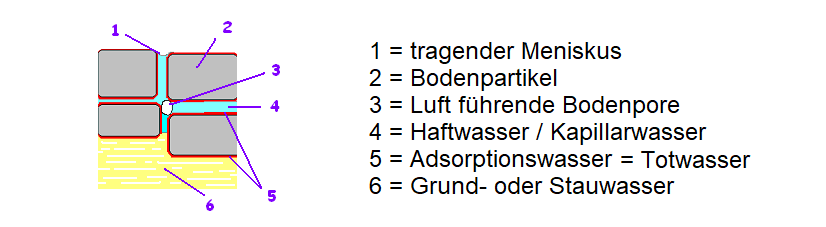
Soil water: Figure 1 = load-bearing meniscus, Figure 2 = soil article, Figure 3 = air-bearing soil pore, Figure 4 = adhesive water/capillary water, Figure 5 = adsorption water= dead water, Figure 6 = groundwater or stagnant water
The infiltrating water displaces the air first in the fine pores until finally, when the soil is moist, air remains only in the coarse pores. Adhesive or capillary water is water held against gravity that adheres to pores smaller than 10 µm (10 thousandths of a mm) due to the surface tension of the...
![]()
wein.plus is a handy, efficient guide to a quick overview of the colourful world of wines, winegrowers and grape varieties. In Wine lexicon, the most comprehensive of its kind in the world, you will find around 26,000 keywords on the subject of grape varieties, wineries, wine-growing regions and much more.
Roman Horvath MW
Domäne Wachau (Wachau)