wein.plus
Attention
You are using an old browser that may not function as expected.
For a better, safer browsing experience, please upgrade your browser.


You can also use our powerful search function with many flexible filters, such as:

Log in Become a Member

Plutonite

Solidified deep rock; see under geology.

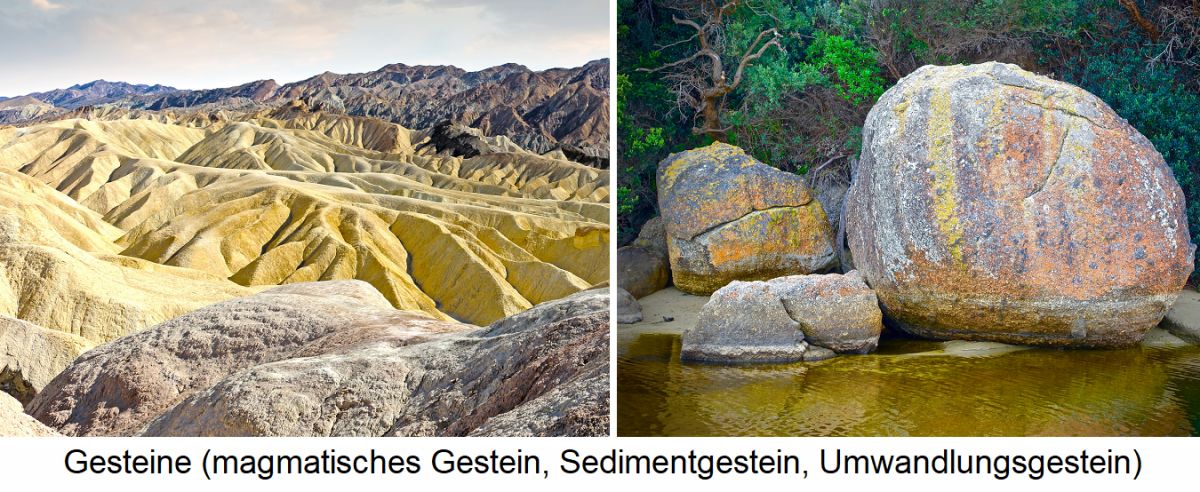
Geology, which is part of the geosciences, deals with the composition and structure of the earth's crust (earth = grch. Ge), its physical properties and its history of development as well as the processes that shape it. Mineralogy deals with the individual, sometimes microscopically small components of rocks, the minerals. Palaeontology deals with the fossil content (fossilised remains of plants or animals) of sedimentary rocks. Each rock in the earth's crust can be assigned to one of the three major rock classes based on its specific formation (microstructure, structure). Each of these can be transformed into a rock of the other two by geological processes (rock cycle):

  • Magmatites: crystalline or solidified rocks
  • Sediments: layered rocks
  • Metamorphites: metamorphic or remodelled rocks

Geologie - Gesteine (magmatisches Gestein, Sedimentgestein, Umwandlungsgestein)

Magmatites - crystalline or solidified rocks

Magmatites are formed by cooling and solidification. They are categorised into plutonites (deep rocks) and volcanites (effusive rocks) according to their solidification depth. Plutonites are formed when rising magma slowly cools long before reaching the earth's surface and mineralises in large crystals.

Common crystalline deep rocks are granite, mica schist and gneiss. When molten magma cools, hard, dense solidification rocks such as basalt or obsidian are formed. In the case of volcanites, liquid magma erupts as lava on the earth's surface to cool in water or in the air. Gas-filled tuff rocks are formed from...

Voices of our members

Roman Horvath MW

wein.plus is a handy, efficient guide to a quick overview of the colourful world of wines, winegrowers and grape varieties. In Wine lexicon, the most comprehensive of its kind in the world, you will find around 26,000 keywords on the subject of grape varieties, wineries, wine-growing regions and much more.

Roman Horvath MW
Domäne Wachau (Wachau)

The world's largest Lexicon of wine terms.

26,673 Keywords · 47,061 Synonyms · 5,312 Translations · 32,004 Pronunciations · 240,750 Cross-references
made with by our author Norbert F. J. Tischelmayer. About the Lexicon

EVENTS NEAR YOU

PREMIUM PARTNERS