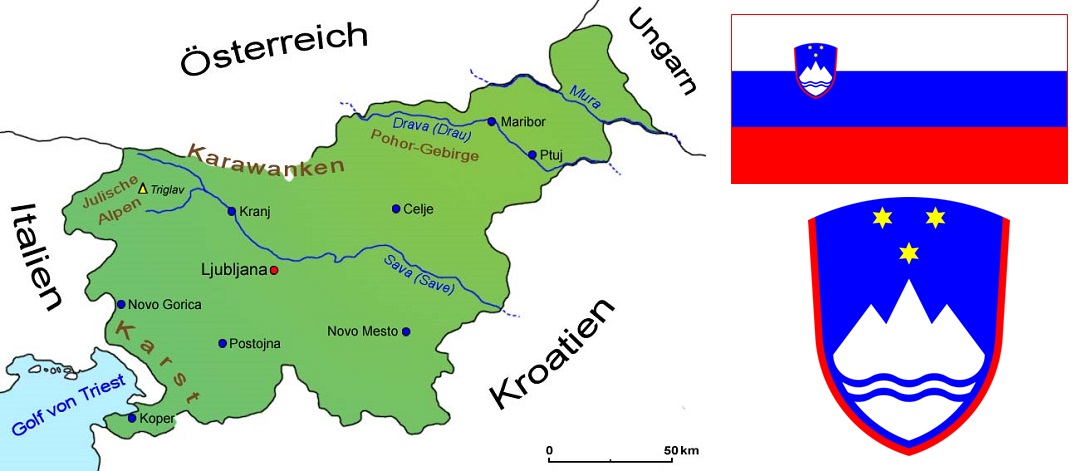
The Republic of Slovenia (Slovenija in Slovenian) with its capital Ljubljana covers an area of 20,273 square kilometres. The country borders Italy to the west, Austria to the north, Hungary to the east and Croatia to the south-east. After the end of the Second World War in 1945, Slovenia existed as a constituent republic of socialist Yugoslavia. Following the declaration of independence in 1991 and the 10-day war, Slovenia became an independent nation state.
History
The first vines were planted by the Celts around 2,400 years ago. The Romans influenced viticulture, particularly in the Poetovium region (Ptuj = Pettau). The Roman wine writer Pliny the Elder (23-79) mentioned viticulture in the Karst region and described these wines as the elixir of life. Viticulture came to a standstill again during the Migration Period. But in the Middle Ages, the wines were highly prized at the courts of imperial Vienna and archbishopric Salzburg. The Austrian Archduke Johann (1782-1859) owned a model vineyard near Maribor (Marburg). The influences of the region's long historical affiliation with Austria-Hungary can still be felt today. As in most European countries, large areas of vineyards fell victim to phylloxera in the second half of the 19th century.
Climate & soils
The climatic conditions are characterised by Alpine, continental and Mediterranean climates. Short, heavy downpours in spring are followed by a warm summer and a long, mostly sunny autumn, which enables a late grape harvest and thus also ripe Prädikat wines. The soils are characterised by great diversity (see under the wine-growing regions).
Wine-growing regions
The wine-growing areas lie to the north on the border with Austria (South Styria), to the east with Hungary and to the west with the Italian region of Friuli-Venezia Giulia. Around three quarters of production is accounted for by white wines and around one quarter by red wines. The Movia winery is a model and pioneer. There are many small winegrowers with tiny plots. Slovenia is divided into three large wine-growing regions with 14 protected wine-growing areas.
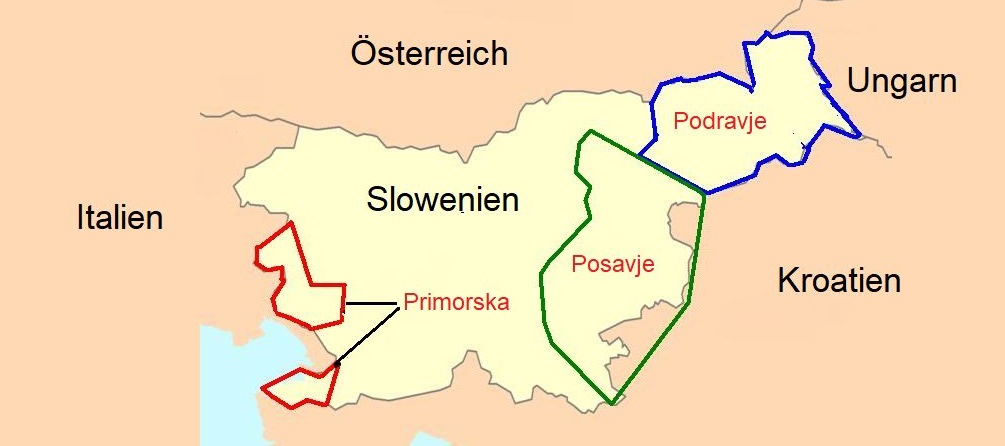
Podravje (Drauland) with 9,650 ha
Is divided into two areas:
Stajerska Slovenija (Slovenian Styria) with 8,685 ha
- Haloze
- Ljutomer-Ormoz
- Maribor
- Ptuj-Srednje Slovenske Gorice
- Radgona-Kapela
- Smarje-Virstanj
Prekmurje with 965 ha
Posavje (Sava region) with 4,328 ha
- Bela Krajina (White Carniola) with 608 ha
- Bizeljsko Sremič with 1,264 ha
- Dolenjska with 2,456 ha
Primorska (Adriatic coastal area) with 8,081 ha
- Goriška Brda (Gorizia hills) with 1,992 ha
- Kras (Karst) with 753 ha
- Slovenska Istra (Slovenian Istria) with 2,331 ha
- Vipavska Dolina (Wippach Valley) with 3,005 ha
Grape variety index
In 2022, the vineyards covered 14,789 hectares and the Wein-Produktionsmengenwine...