The Autonomous Region of the Canary Islands (Spanish: Islas Canarias) belongs to Spain and is located in the Atlantic Ocean off the northwest coast of Africa at the level of Morocco. The archipelago consists of eight inhabited and a number of uninhabited islands and covers a total of 7,447 km². The distance to mainland Spain is 1,100 km, but the easternmost island, Lanzarote, is only 100 km from Africa. 550 km to the north is the Portuguese archipelago of Madeira. The north-south extension of the Canaries is 212 km and the west-east extension 340 km. The region consists of two provinces, each with a capital:
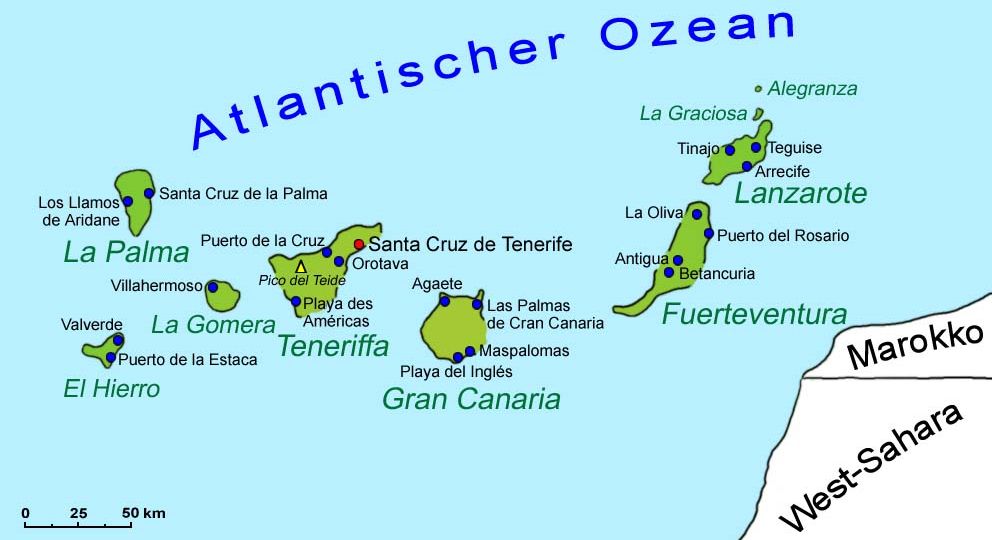
- Santa Cruz de Tenerife with the 4 islands La Gomera, La Palma, El Hierro and Tenerife (capital is Santa Cruz de Tenerife).
- Las Palmas with the 3 islands Fuerteventura, Gran Canaria and Lanzarote (capital is Las Palmas de Gran Canaria)
History
When the Romans landed on the island of Fuerteventura in ancient times, they found numerous packs of wild dogs, so they named the island "Insula Canaria" (Island of Dogs). In 1402, a Spanish ship landed on Gran Canaria and found the original Guanche population there, living as they did in the Stone Age. The Spaniards and Portuguese brought their native grape varieties with them until the end of the century and founded viticulture. At that time, sweet, alcohol-heavy wines were popular, made from the white varieties Moscatel and Malvasia. The wine was called "canary sack" and was exported in large quantities to England and northern Europe. By the time of William Shakespeare (1564-1616), the island wine was already famous; in "What You Will", Sir Toby Belch asks for "a cup of canary".
Climate & Soils
These are volcanic islands. For this reason, the soil is volcanic and ideally suited for viticulture. The most recent eruption from September 2021 on La Palma caused severe damage by destroying vineyards. The subtropical and pleasant climate, which is constant throughout the year, has earned the archipelago the nickname "Islands of Eternal Spring". The flora is characterised by a high biodiversity and a high proportion of...