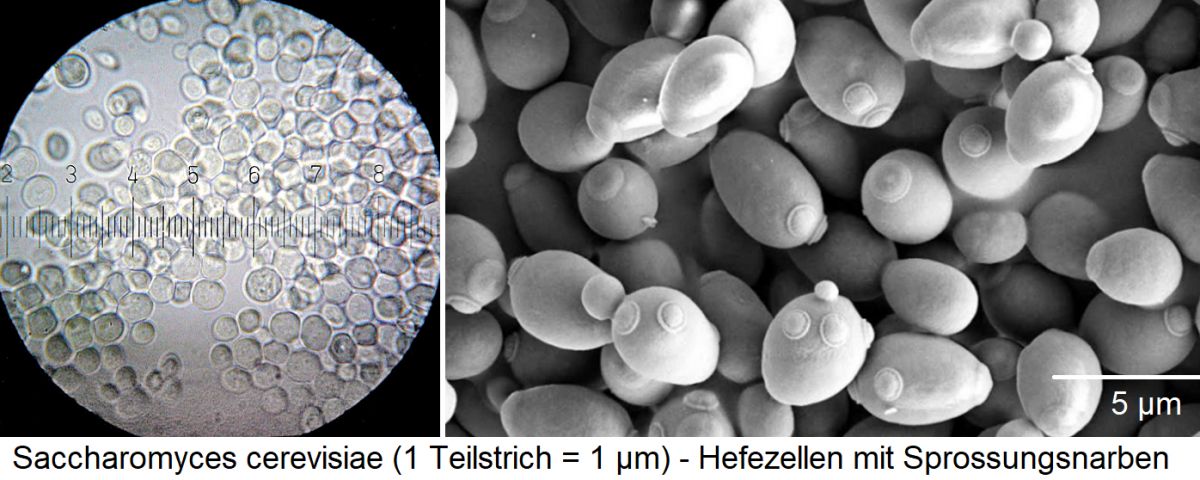
Single-celled microorganisms belonging to the fungi (thallophytes = plants without roots and leaves), in spherical, oval, elongated to cylindrical or pointed form. They range in size from 5 to 14 thousandths of a millimetre (but are significantly larger than bacteria). Most of them reproduce furiously by cell sprouting, which is why they are also called "sprouting fungi". This process can take place up to 35 times. In the process, the yeasts mainly need sugar as a source of energy, as well as some nutrients and trace elements, most of which are present in grape must. The yeasts play a crucial role in winemaking. During fermentation, the sugars glucose (grape sugar) and fructose (fruit sugar) are converted into ethanol (alcohol) and carbon dioxide. The French scientist Louis Pasteur (1822-1895) earned special merit for his research into this complex process.
Anaerobic and aerobic process
The process usually takes place for the most part under anaerobic conditions (meaning absence of oxygen). Areobic conditions in the presence of oxygen are, however, important before or at the beginning of fermentation, as the yeasts can only multiply in an oxygen-rich environment. Glucose is processed much faster, which is why the residual sugar is mainly fructose. Louis Pasteur reported as early as 1861 that yeasts consume much less sugar in an aerobic environment. However, at higher glucose levels in the grape must from about 100 mg/l, alcohol can also be formed under aerobic conditions. This is called the Crabtree effect (or Pasteur effect). At low glucose levels, yeasts directly metabolise the sugar in the presence of oxygen, so it is not converted into alcohol.
Yeast genera and species
The most important yeast genus is "Saccharomyces" (sugar fungi), of which there are over 100 different species. The species most commonly involved in the fermentation of wine, beer and sourdough is "cerevisiae" (grain), aptly named "brewer's yeast" or also "baker's yeast". An older name is "Saccharomyces ellipsoideus" due to the mostly elliptical shape of these yeasts. The naming and classification of the different yeasts are extremely complicated. DNA analyses have shown that many of the previously assumed relationships, and thus also the names, are incorrect. The taxonomic order will certainly change quite a bit in the future due to these new findings.
Natural yeasts (wild yeasts)
More than a dozen different yeasts are present in the vineyard. They are called natural yeasts, wild...