
See under nutrients.
Depending on the type of soil and the geological and climatic conditions, the roots of the vine can penetrate to a depth of 15 to 20 metres. However, they cannot absorb the nutrients in solid form. Weathering converts the substances into tiny particles, which can then be absorbed by the roots in an aqueous solution. The soil water containing the nutrients is called soil solution.
The uptake of nutrients in ionic form takes place primarily through the roots. The uptake is mainly limited to gas exchange such as carbon dioxide and oxygen and the regulation of the water balance. The water is released in the form of water vapour (transpiration). This helps the plant to release excess heat and absorb nutrients from the soil through transpiration. However, other substances can also be absorbed in dissolved water form via the leaves through foliar fertilisation.
A good vineyard soil is characterised by a balanced water balance (with good water retention capacity and water drainage without waterlogging and without water stress or heat stress). In most European wine-growing regions, the water supply is left to nature, as artificial irrigation is generally prohibited for quality wines and requires authorisation in exceptional cases.
The pH value of the soil should ideally be between 5.5 and 7.0 in order to optimise the availability of nutrients. Humus and organic matter in the soil play an important role in nutrient availability and soil structure. They promote microbial activity and improve the water-holding capacity of the soil.

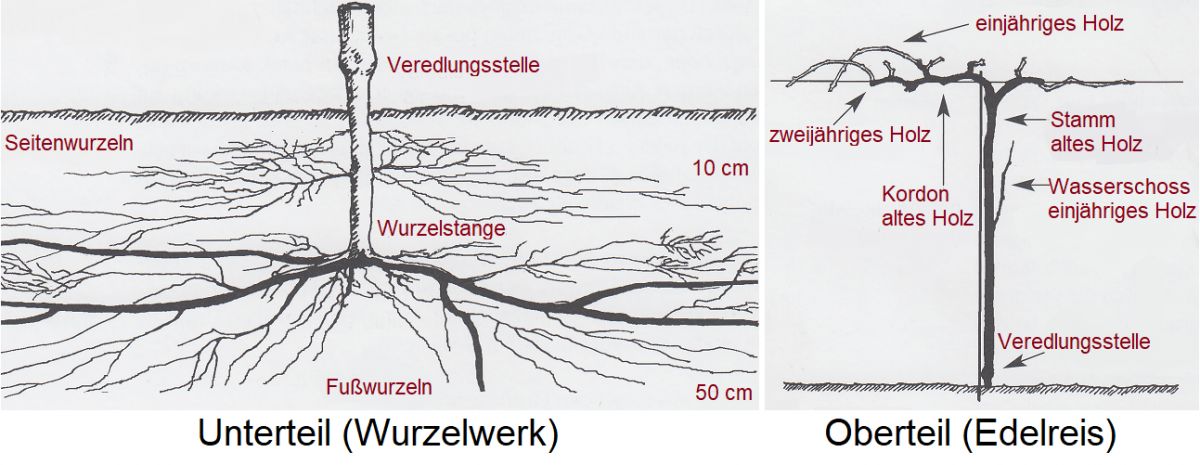
Lower part (root system): 1 = Grafting point, 2 = lateral roots, 3 = root stem, 4 = foot roots
Upper part (scion): 1 = one-year-old wood, 2 = biennial wood, 3 = cordon of old wood, 4 = trunk of old wood, 5 = water shoots one-year-old wood, 6 = grafting site
As a rule, a distinction is made between nutrients and trace elements, whereby this difference is intended to express the quantity requirement but not the quality. In plant physiology, both groups play important roles in many essential processes such...
![]()
wein.plus is a handy, efficient guide to a quick overview of the colourful world of wines, winegrowers and grape varieties. In Wine lexicon, the most comprehensive of its kind in the world, you will find around 26,000 keywords on the subject of grape varieties, wineries, wine-growing regions and much more.
Roman Horvath MW
Domäne Wachau (Wachau)