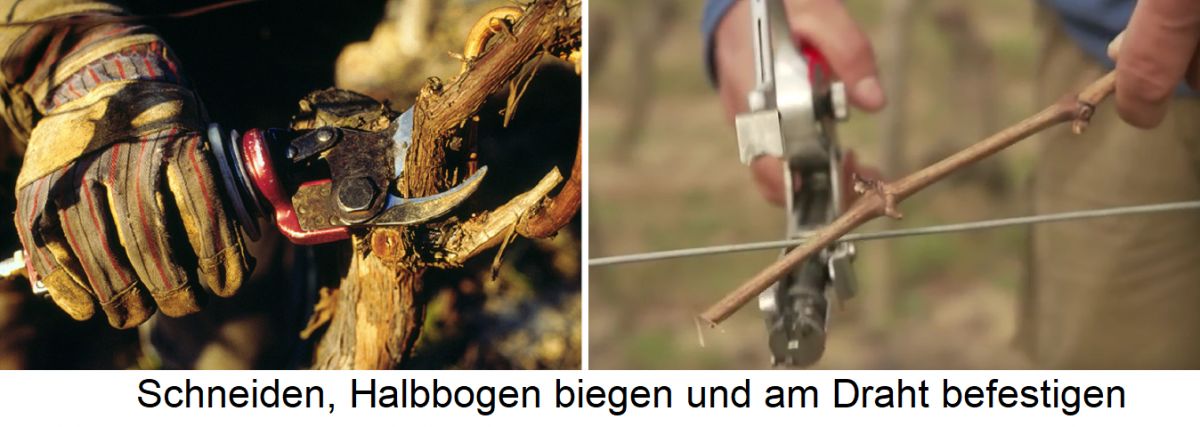
Important factor for the yield and quality of a wine. Without pruning, the vine would proliferate uncontrollably and from the buds of each of last year's shoots build up new stocks every year, which would spread out in tiers, while the lower stocks would become woody. Since grapes are only ever formed on one-year-old wood, pruning ensures a balance (physiological equilibrium) between yield (generative growth) and growth (vegetative growth) without producing too much old, unproductive wood. The choice of the appropriate method depends on the soil type (fertile-barren), the vine training (single vine, wire frame, pergola), the climate (humid-dry), the grape variety (fertility, tendency to coulure), the rootstock, as well as specific local conditions.
Timing
The ideal time for winter pruning is the last stage in the annual vegetation cycle, the winter dormancy (sap dormancy); in the northern hemisphere on frost-free days in early spring from January to February, in the southern hemisphere from July to August. After that, the annual vegetative cycle of the vine begins anew with budbreak. There are different methods, for which there are individual legal regulations in many wine-growing countries, mainly for the production of quality wines. These can vary depending on the wine-growing region or even in smaller areas (appellations) and sites; in Champagne, for example, four forms are permitted. In Friuli, the Simonit & Sirch method was developed, which assumes pruning only on young wood.
The most complex form is the manual...