The terms for testing and evaluating wine through human-performed "smelling and tasting" are numerous, a few of which are, for example, degustation, tasting, wine tasting and wine tasting. This is a sensory examination of the organoleptic properties of a wine with a descriptive explanation of the findings obtained in the process according to established rules and criteria using generally valid and understandable terms (see wine talk). This is not done in a scientific-analytical way with technical or other aids, but sensory "only" through the sensory organs such as eye, nose, palate and tongue. This may result in an evaluation by awarding points according to various systems. As a supplement to this, however, there are also possibilities to carry out an objective measurement by means of exact, chemical analyses. This is, for example, the determination of alcohol content, total extract, residual sugar, acids, sulphur and other substances.
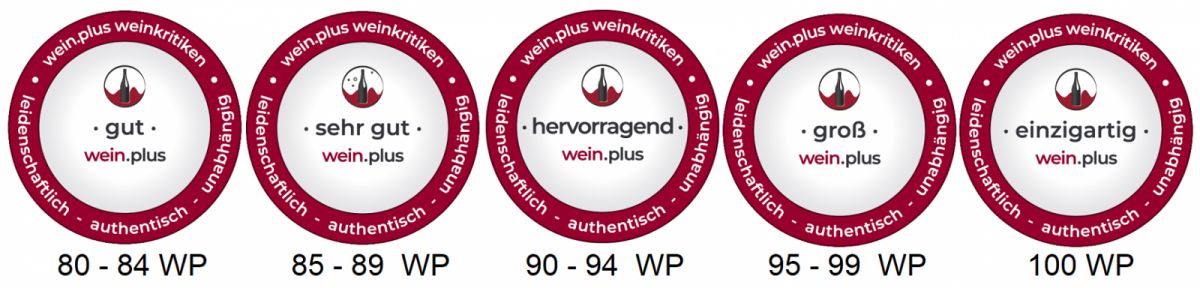
Sensory tasting & analytical testing
Nevertheless, one cannot do without a "subjective" test with sensory tasting by humans. The two methods complement each other and only in combination result in a "fair" assessment. A person can determine the taste "sweet", but never exactly how many grams of sugar are contained in a litre of wine. Analytical testing, on the other hand, cannot determine whether a wine "tastes" good. There is the phenomenon of national preferences and rejections. In general, Austrians and Germans prefer acidic tastes, Italians bitter, Americans sweet and French astringent, although such generalisations should be viewed with caution. The lighting in a room also influences the taste of a wine: for example, it tastes better in red and blue light than in green or white light, as scientists at the Psychological Institute of the Johannes Gutenberg University in Mainz found out. The study showed that the test wine tasted about 1.5 times sweeter under red light than under white or green light. The fruitiness was also rated highest under red light.
Professional tasting
Professional tasters can, however, disregard such influencing factors and judge a wine quite "fairly" and "objectively" by, of course, disregarding their personal likes and dislikes as much as possible. However, this can only be achieved through years of practice and experience. In order to eliminate influences from external circumstances such as the lighting mentioned above, professional tastings take place in a sparsely furnished, neutral environment. The famous English taster Michael Broadbent (1927-2020) tasted over 70,000 wines. But it is precisely he who does not use any of the scoring systems described below in his evaluations, instead awarding one to five stars. Likewise, the well-known wine author Hugh Johnson uses his own scheme with 12 levels. In addition to theoretical knowledge, the following skills are required: Smell acuity, ability to distinguish and remember, ability to concentrate and the greatest possible objectivity. The perception threshold plays an important role. This is the limit in the mg/l range and below which one can identify and name a substance.
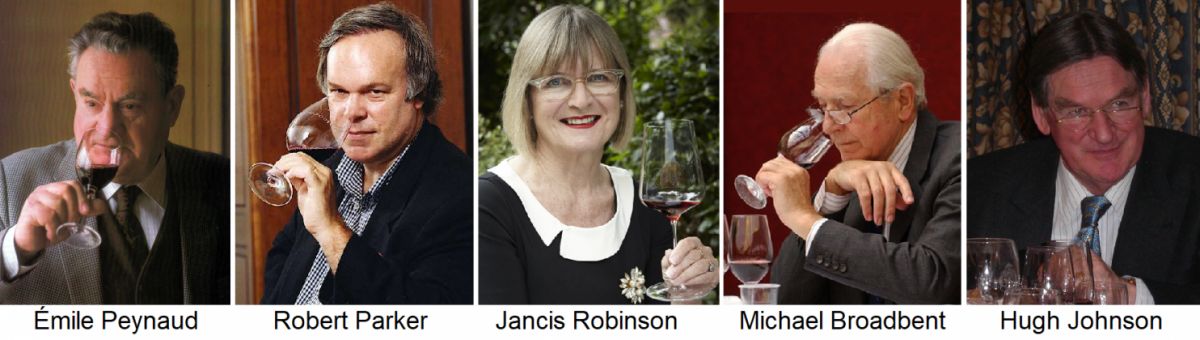
Professor Emile Peynaud (1912-2004), who is one of the most famous tasters, writes the following about this in his standard work "Hohe Schule für Weinkenner" (High School for Wine Connoisseurs), which has been published several times:
To say that something is sweet is an objective statement; it characterises the product in question. To say, for example, that a cup of coffee is sufficiently or insufficiently sweet; is a subjective statement; it is personal; it depends on a person's drinking habits and taste. But if one says that sugar tastes unpleasant; that one detests everything that is sweet, then one is expressing an affective opinion. The professional taster must be able to switch off his affectivity. He should not say whether he likes or dislikes a wine. You don't want to know that from him. He must study the wine, describe it, judge its good or bad organoleptic qualities and draw conclusions. These will be subjective, but they must not be based on personal preference, at least as little as possible. This is the great and decisive difference with the untrained wine drinker, whose judgement is purely affective."
Different assessment results
Nevertheless, even absolute specialists can have different evaluations of the same wine, although this usually only accounts for a few points (if at all). With several scales, even from different manufacturers, one can very well assume that weighing an object to at least a tenth of a gram will produce the same result. After all, the scales are all calibrated and almost identical in terms of their composition. But this cannot be the case with people, because the palate and tongue as well as experience and preferences of different people are certainly not the same. A different result is therefore not inevitable, but also not surprising.
An exemplary example of an extremely different rating is the rating of the red wine of Château Pavie vintage 2003, where Robert Parker awarded 96/100 points and Jancis Robinson 12/20 points (below is the formula for the conversion between the 20 and 100 system). Accordingly, Robinson's 12/20 points correspond to 76/100 points - which means a "simple wine without faults". Parker's 96/100 points mean a "great world-class wine". However, the two did not taste from the same bottle. Two bottles may very well have differences in quality for different reasons, which is called bottle variance.
As a rule, wine ratings have no scientific validity. If the competition were to be repeated the next day with the same judges and the same wines, the results would not be completely different, but it is highly probable that the evaluation figures would differ to a large extent. In the sense of a scientifically recognised result, however, they would have to be repeatable, i.e. at best completely identical. One can assume that the higher the knowledge, experience and professionalism of the tasters, the smaller the differences between two evaluation rounds. In this regard, see the legendary international competition between France and California under Paris Wine Tasting.
The occasion of a tasting
A wine is tasted to determine its quality for various reasons. In the course of an official inspection, professional control bodies determine, among other things, whether the wine meets the requirements of wine law. This is the case, for example, when the official test number (Germany) and the state test number (Austria) for quality wines are awarded. In addition to analytical testing using chemical and technical aids, sensory testing is also carried out by the senses. Another reason can be a competition in which different wines are tasted, evaluated and prizes are awarded according to the results. The third reason can be of a purely private nature. Either to educate oneself, to enjoy wine with friends and talk about it, or to find out the best value for money when buying wine. The criteria are very similar, however, and in any case they must be precisely defined and known beforehand so that all tasters start from the same basis.
General conditions
The best time for a tasting is later in the morning because the sensory organs are most receptive and "fresh". A cold, medication, spicy or strongly seasoned food, coffee, acidic fruit, tobacco, chewing gum and perfume are disturbing or can have a negative influence. The room should be well lit and free of foreign odours. The ideal room temperature is around 20 °Celsius. A white table background for checking the colour is a prerequisite. The following rule of thumb applies to the order of different wines: dry before sweet, young before old and smaller before large wines. Regarding wine colour, the following applies: dry light white wines before heavy red wines, but young light red wines before white wines rich in extract. Since there are good reasons for not swallowing at professional tastings, suitable containers (spittoons) should be available. Since there are no nerves in the throat for the sensation of taste and smell, this does not detract from a serious examination. Lay people sometimes doubt this, but it is...