Total extract (dry extract) refers to all substances that occur dissolved in the wine and remain after distillation (evaporation) of the aqueous-alcoholic portion. The total of all minerals and trace elements is referred to as ash, the quantity of all acids as total acidity and the quantity of all sugars as residual sugar. Around 7,000 different substances have been identified in wine using metabolomics(a method of analysis).
This allows not only the ingredients present in a wine to be determined, but also the quality and origin, as well as any manipulation or wine adulteration that may have taken place. The calculation is carried out in grams per litre (g/l) to an accuracy of 10-1. The vast majority is still unknown. The 50 or so most common ones, together with their interaction, make up the composition or the very special quality of a wine.
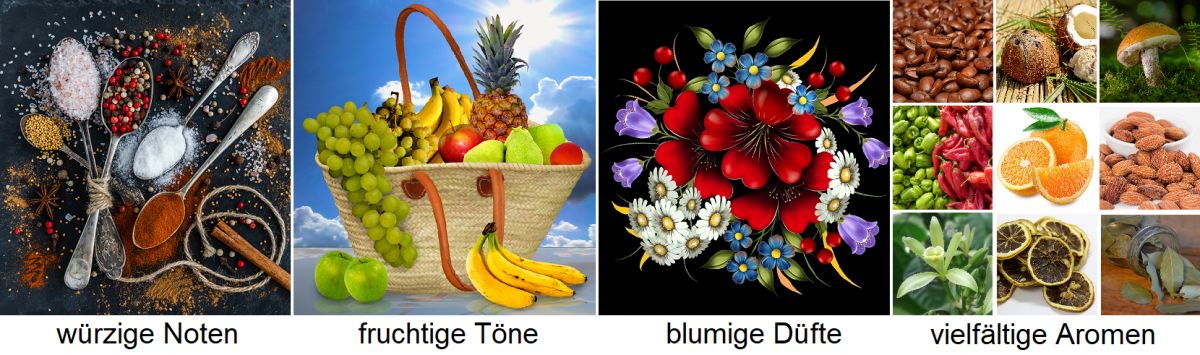
Formation of the ingredients
The total extract content of a wine is primarily determined by the amount of precipitation and climatic conditions during the growing season (as all substances are water-soluble), the root system of the vine (the older the vine, the more extensive the root system) and the type of soil with its nutrients. The lower the yield, i.e. the fewer grapes a vine bears, the higher the total extract. The time of the grape harvest also plays an important role. The later the harvest, the higher the values tend to be. However, it is not only the must weight that is decisive; the grapes should also be as physiologically ripe as possible.
Varietal flavours
The various aroma compounds in particular characterise the aroma or bouquet of a wine and can be clearly identified and named by a professional taster when evaluating a wine. This can also be learnt through practice. Even inexperienced people can (could) usually recognise the aromas of bitter almond, butter, blackcurrant, strawberry, clove, yeast, coffee, cherry, coconut, nutmeg, paprika, pepper, vanilla, lemon and plum relatively easily. Each grape variety potentially has its own characteristic, varietal flavours.
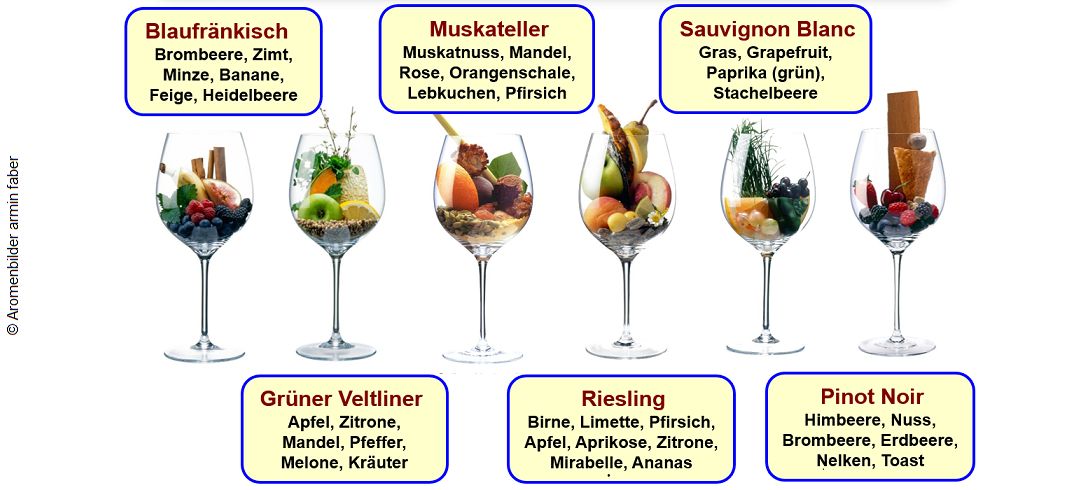
Wine ingredients
The grape must is usually extracted...