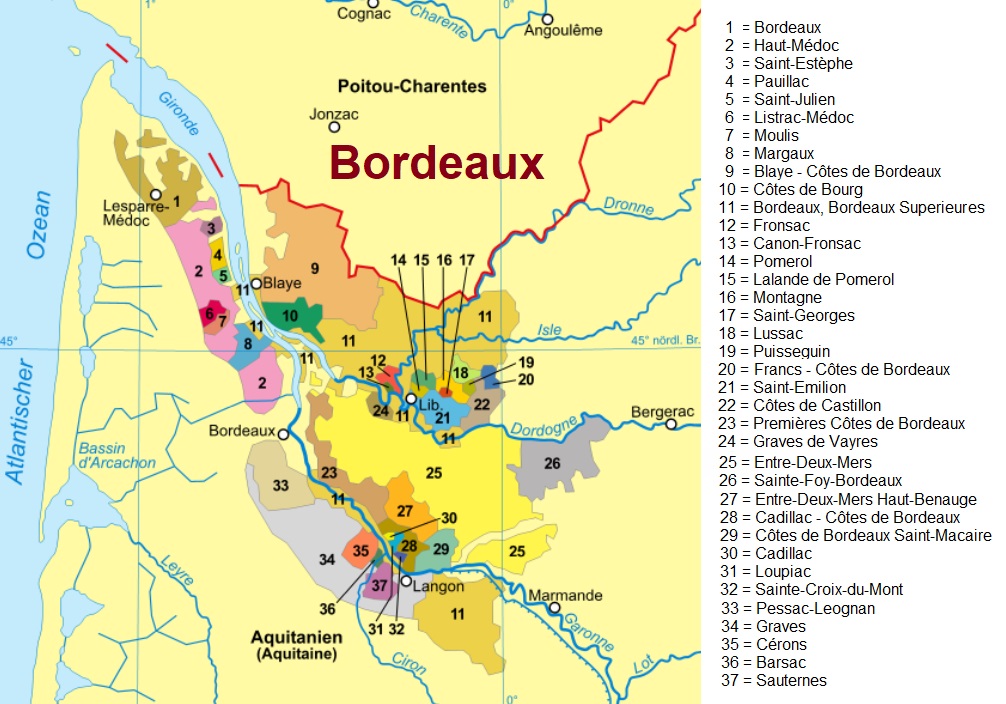
Wine estates (châteaux) and wines in Bordeaux have been classified since the 18th century. Today, there are five systems; the most famous dates back to 1855, but only wines from the left bank (rive gauche) of the Gironde were taken into account, including the Médoc, Graves and Sauternes areas. Of course, excellent wines also grow on the right bank (rive droite), such as Fronsac, Pomerol and Saint-Émilion. The classification, which is over a century and a half old, applies regardless of the quality of the wines, which certainly varies from year to year. So far, there has only been one absolute exception, when Château Mouton-Rothschild was promoted from 2nd to 1st place. It is still very important and is therefore used by the wineries for marketing purposes, with the rank indicated on the label.

Bordeaux classification systems
The remaining four systems in force today for other Bordeaux areas (which were not taken into account in 1855) were only introduced much later. The cru classes differ in their designation and the number of quality levels, which is confusing compared to the standardised Burgundy classification system that applies to all appellations. There have been repeated attempts at standardisation. One proposal came from Alexis Lichine (1913-1989), which was never realised.
- Médoc (as well as Château Haut-Brion, a vineyard from Graves) for red wines with five levels - 1855
- Cru Bourgeois (Médoc) with one level - from the 1920s, recognised by EG in 1976
- Cru Artisan (Médoc) with one level - 1989, recognised by the EU in 1994
- Graves for red and white wines with one level - 1953 and 1959 respectively
- Saint-Émilion with two levels - recognised every 10 years from 1955
- Sauternes and Barsac for white wines with three levels - 1855
The one-tier Cru Bourgeois and Cru Artisan systems apply to Médoc vineyards not classified as Grands Crus and are ranked below the Grands Crus of 1855. The classification, which has already been changed several times, is repeated periodically (see below). For Graves, a single-level classification was created in 1953 and supplemented in 1959, which differentiates between red and white wines (all vineyards are located in Pessac-Léognan). A two-tier system was introduced for Saint-Émilion in 1955; the classification is linked to the sites (vineyards). It is reviewed periodically and the wine estates have to apply. There is no classification in Fronsac and Pomerol, which is an exception in Bordeaux.
The UGCB (Union des Grands Crus de Bordeaux) represents the most important Bordeaux wine-growing regions, represents the interests of independent winegrowers and acts as a marketing platform, particularly for international customers. In addition to the UGCB, there are other regional organisations with similar objectives, namely the Alliance des Crus Bourgeois du Médoc, the Classement des Vins de Graves and the Classements des Vins de Saint-Émilion.
The 1855 classification
From 15 May to 15 November 1855, the Universal Exhibition was held in Paris under the aegis of Napoleon III (1808-1873). The most important exhibition venue was temporarily erected between the Champs-Élysées and the Seine. In preparation for this event, the monarch instructed the Bordeaux (Gironde) Chamber of Commerce to compile "a complete list of classified Bordeaux red wines as well as our great white wines". The wines of the right bank of the Dordogne were not included because these appellations were under the...