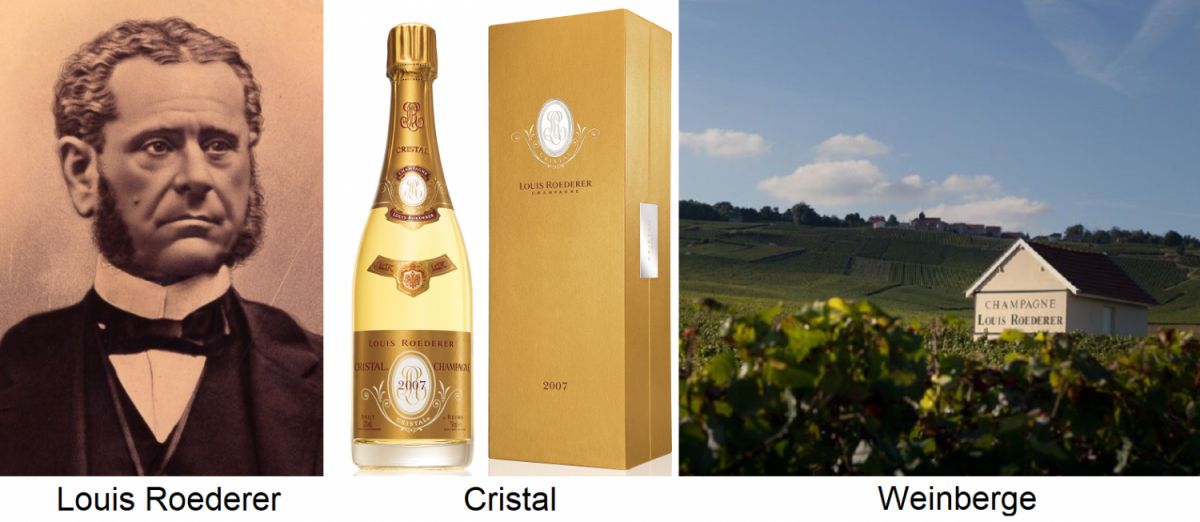

The Cuvée de Prestige of the Champagne House Roederer; see there.
The origins of the champagne house in Reims lie in the company Dubois Père et Fils, which was first mentioned in 1760. The company later became the property of Nicolas-Henri Schreider (1752-1828), who is considered the official founder in 1776. He employed his nephew Louis Roederer (1809-1870) in 1827. After Schreider's death, the heir renamed the company Roederer. He succeeded in opening up new markets in America and England, as well as winning over the Russian Tsar Alexander I (1777-1825) as a buyer of his champagne. In 1870, Louis Roederer II (1846-1880) took over the management of the company, which had expanded considerably in the meantime.

The Russian court remained loyal to Roederer champagne under Tsar Alexander II (1818-1881). An extremely sweet champagne was produced for Alexander, which was particularly appreciated at court and in aristocratic circles. Fearing the frequent assassinations at the time and inspired by a bottle of Mercier champagne, the tsar's cellar master demanded transparent bottles so that a poisoned champagne could be quickly recognised visually. Roederer complied and the champagne was first delivered to Russia in 1876.
The brand, known as "Cristal", was bottled in clear crystal glass bottles with a flat base. The flat base of the bottle was intended to prevent a small explosive device from being placed in the recess. Like all other products, this brand,...
![]()
The glossary is a monumental achievement and one of the most important contributions to wine knowledge. Of all the encyclopaedias I use on the subject of wine, it is by far the most important. That was the case ten years ago and it hasn't changed since.
Andreas Essl
Autor, Modena