The area between Lake Geneva (Switzerland) and the Rhône Valley (France) is thought to be the original home of the Pinot vine. It is unlikely that it originated in Italy because of the synonym Clevner. The Cistercian order brought it to the Rheingau in the Middle Ages, from where it then spread throughout Europe. According to the most likely variant, the French term "Pinot" is derived from the elongated grape shape, which is quite similar to the cone of a pine tree (French "pin"). The oldest names for the Pinot grape, some of which are still used today, were Auvernat, Morillon and Noirien in various spellings, but confusingly these were also used for other varieties.
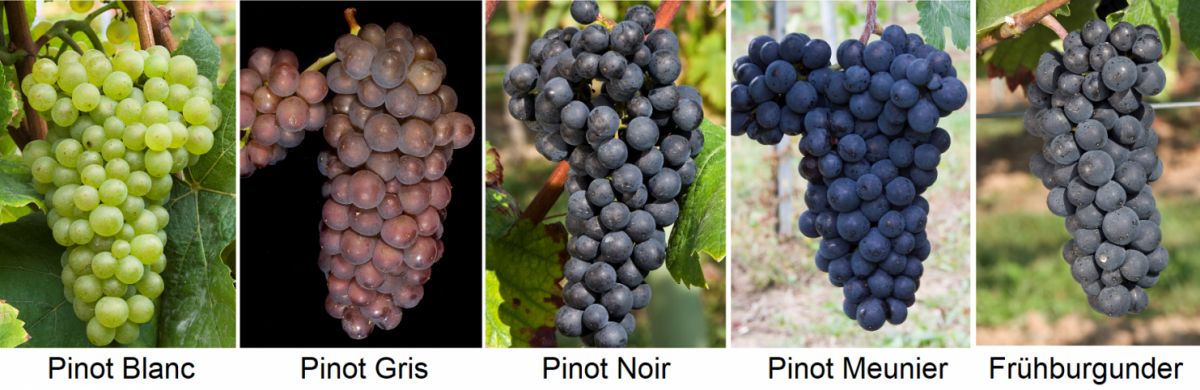
It was first mentioned as Moreillon in 1283 in the municipality of Beauvais near Paris. The name Pinot first appeared in 1375 in an edict of the Duke of Burgundy Philip II the Bold (1342-1404), in which he ruled in favour of Pinot Vermeil against the widespread high-yielding but low-quality Gamay variety. A mention of Pinot (mz. of Pinot) in 1394 indirectly indicates that there are several Pinot varieties. Until then, no/hardly any species/colours were mentioned. From the 15th century onwards, various spellings such as Pignotz, Pinot, Pynos, Pinotz, Pineau etc. were used. It was not until 1896 that the standardised name Pinot was adopted at a congress in Chalon-sur-Saône (Burgundy).
Ancestry
The ancient grape variety Allobrogica, mentioned by the Roman writer Columella (1st half of the 1st century) and Pliny the Elder (23-79), could possibly be an ancestor. There is no genetic or botanical evidence to support the assumption that it came to France from Egypt via Greece. It cannot be proven (but is not impossible) that Emperor Charlemagne (742-814) brought it to the Rhine and had it planted there at his palace in Ingelheim (Rheinhessen). And the fact that his great-grandson Charles III, known as Charlemagne the Fat (839-888), had the variety planted in his "royal vineyard" near Lake Constance in 884 is not proven, as no variety names are mentioned in the document in question.
The parentage is still not 100% clear. No genetic relationship has yet been established for the descent from wild vines assumed by the ampelographer Louis Levadoux in 1956. DNA analyses carried out at the Klosterneuburger Weinbauinstitut...