The term for alcoholic fermentation used to refer to the apparent "boiling" or "foaming" in grape must. Fermentation is understood to be the microbial degradation of organic substances without the inclusion of external electron acceptors such as nitrate or oxygen (i.e. anaerobic) for the purpose of energy production. However, the degradation of organic substances can also take place with the inclusion of oxygen (aerobic). For example, acetic acid fermentation consumes oxygen, which is why it is not a fermentation in the scientific sense as described above. The term fermentation, on the other hand, is an umbrella term for aerobic and anaerobic processes. This often leads to confusion because in other languages "fermentation" is used for alcoholic fermentation or there is no separate term for it.
Cause of fermentation
The process was long thought to be a natural decomposition. The influence of air (even when oxygen had already been discovered) was ignored. This is why even today breweries still use the advertising slogan "just malt, hops and water", which is actually incomplete. For this reason, the processes involved in converting must into wine, wort into beer and wine into vinegar were referred to as fermentation. The involvement of previously unknown microorganisms was recognised by the French chemist Louis Pasteur (1822-1895) in 1857.
Fermentation occurs spontaneously without human intervention wherever yeast fungi come into contact with aqueous sugar solutions at an optimum temperature of between 18 and 27 °C. Such fungi exist in the vineyard and in the wine cellar. Such fungi exist in the vineyard and also in the wine cellar, which is why we speak of vineyard and cellar yeasts. Many producers deliberately allow this instead of adding pure yeasts. As a rule, fermentation starts automatically with grape must or other fruit juices, but it can also be other substances dissolved or added in water, such as cereals (barley, wheat, maize, rice) in the production of beer or other sugary substances such as potatoes or bread.
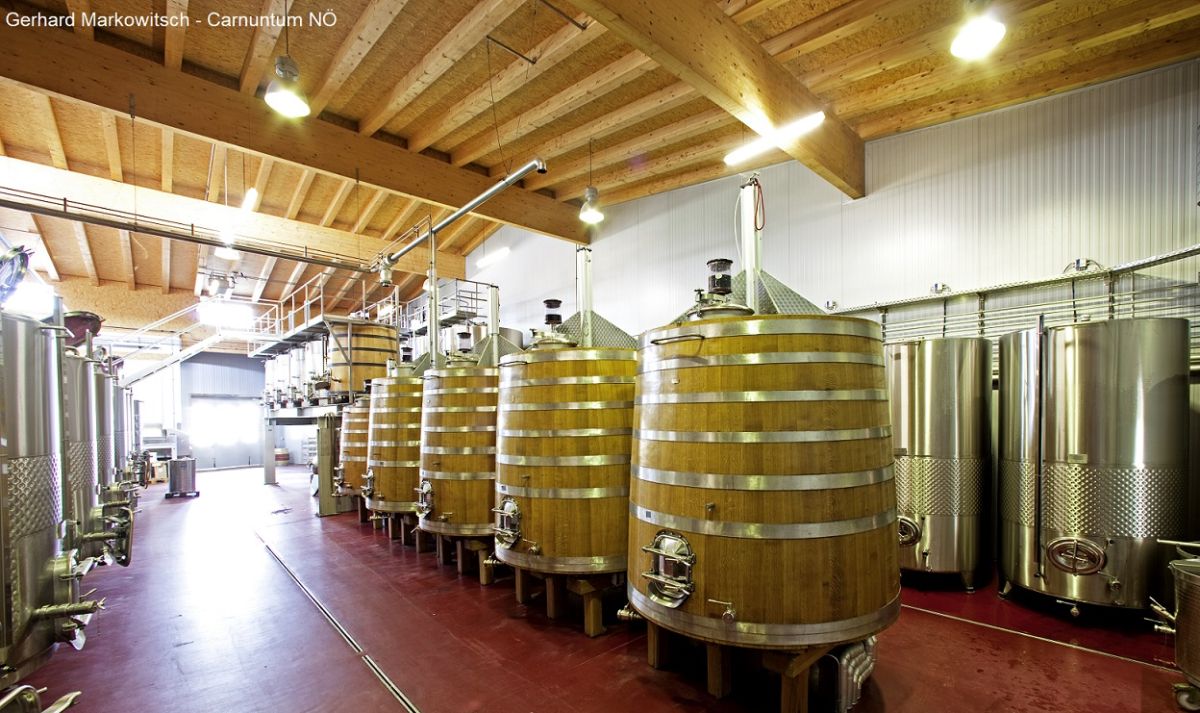
The picture on the left shows open stainless steel red wine tanks for mash fermentation, the picture in the centre shows wooden fermentation racks for mash fermentation and the picture on the right shows stainless steel white wine tanks ( Gerhard Markowitsch winery, Carnuntum Lower Austria).
Yeast types
Yeasts play a decisive role in fermentation. After pressing, they multiply rapidly in the grape must by sprouting and dividing. Towards the end, there are 50 to 200 billion yeast cells per litre of wine. The biochemical processes are controlled by enzymes contained in the yeasts; the zymase complex is responsible for fermentation. Natural or wild yeasts are present in large quantities in the vineyard and elsewhere (air) and enter the cellar with the grapes. They can also trigger fermentation on their own, which used to be common practice. In this case we speak of spontaneous fermentation. However, this is much more difficult to control, but is favoured especially in connection with organic viticulture for organic wines and natural wines.
Pure yeasts (cultured yeasts) are used to initiate the mainly used pure yeast fermentation. These guarantee a fast, complication-free start to fermentation. If necessary, this is supported by starter cultures (also fermentation starters). Saccharomyces cerevisiae is the most important type of yeast involved at the start worldwide. The alcohol-sensitive yeast species die quickly during fermentation, in the case of natural yeasts from around 14% vol. Only the alcohol-resistant (cultured yeasts) survive until they too stop working at 16 to 18% vol. alcohol content. In the production of spirits, "turbo yeasts" are used which are even viable up to 20% vol. Sugar conversion is a multi-stage process caused by the yeast complex zymase. A special type of yeast is flor, which forms during the production of certain types of sherry.
Fermentation process
Fermentation is the enzymatic decomposition of organic substances in an anaerobic environment, i.e. in the absence of oxygen. However, if there is...